PART 1 — INTRODUCTION
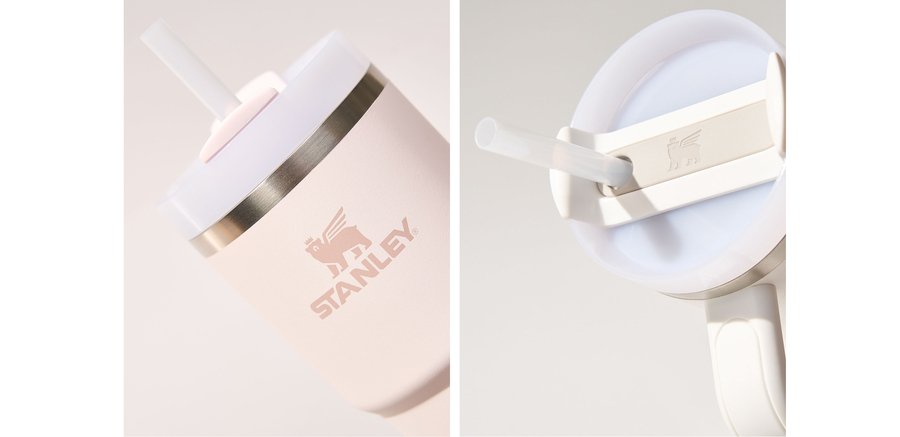
Close ups of Stanley cups from a campaign photoshoot by native
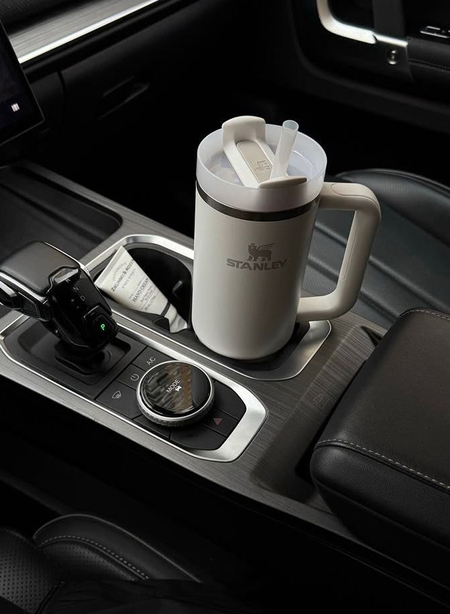
If you’ve opened TikTok in the last two years, you’ve already met Stanley. Open almost any social feed and you’ll see it: a chunky 40-ounce cup with a handle and a straw, photographed on a car dashboard, a gym floor, a university desk, in every colour from sage green to bubble-gum pink. People line up outside Target for it. They own it in six shades. Some of them cry happy tears on camera when they unwrap one. Somehow, a water cup became one of the most talked-about products on the internet. And the strangest part? It’s made by a brand that has been around since 1913.
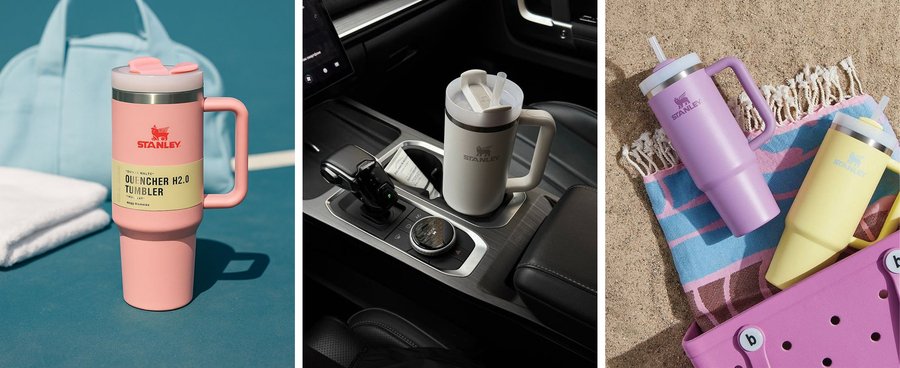
Vaviety of Stanley cup colours
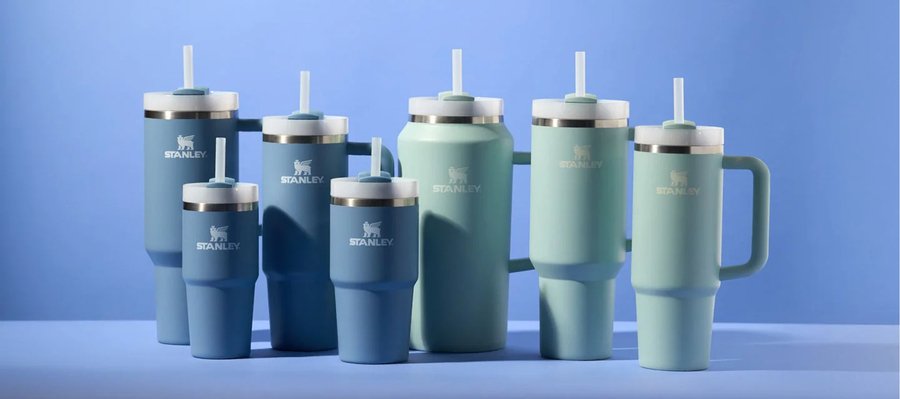
Stanley 1913 cup sizes, Stanley cup blog post
BRAND BACKGROUND
Stanley started with a genuinely clever invention. In 1913, William Stanley Jr. fused vacuum insulation with steel and patented the first all-steel vacuum bottle — the thermos that keeps your coffee hot and your water cold for hours. For most of the next century, that is exactly who Stanley was for: construction workers, soldiers, fishermen, and anyone who needed a flask tough enough to survive a worksite. The brand (today owned by Seattle-based Pacific Market International) built its name on being rugged, reliable, and almost aggressively unglamorous.
Stanley cup 1913 model, Stanley cup blog post
Stanley thermos models form the 70s and 80s
For 100 years, Stanley sold toughness to men. Then it accidentally became a fashion accessory for women. The product at the centre of the storm is the Quencher — a 40-ounce insulated tumbler that Stanley first introduced in 2016. It barely sold. In fact, by 2019 the company had more or less given up on it and stopped prioritising it. The cup that would soon generate hundreds of millions of dollars was, just a few years ago, on its way to being quietly discontinued.
CORE POSITIONING
Stanley no longer sells a water bottle. It sells belonging, identity, and a small hit of dopamine. Today the Quencher is positioned less as 'hydration gear' and more as a lifestyle object — something you collect, match to your outfit, display on a shelf, and identify with. Owning one (or five) signals that you belong to a certain world: organised, aesthetic, always hydrated, a little bit 'that girl'. The cup itself barely changed. What changed completely was the meaning attached to it. That shift, from function to identity, is exactly what makes Stanley such a rich case for communication theory.
Fashion bloggers post with a Stanley cup, Bailey McWhinnie
Caption to a fashion bloggers post with a Stanley cup, Bailey McWhinnie
TARGET AUDIENCE
When Stanley revived the Quencher, it deliberately moved away from its old base of outdoorsmen and workers towards a new one: millennial and Gen-Z women. These are people who live on TikTok and Instagram, follow trends closely, care about aesthetics, and treat the objects around them as extensions of their personality. From there the audience kept widening — to busy mums, to gift-buyers, even to school-age kids who begged for a Stanley for Christmas. But the heart of it stayed the same: a young, female, highly online community for whom the cup is as much a social signal as a drinking vessel. This research follows one question: how did a forgotten flask become an identity — and what does communication theory reveal about how that happened?
Stanley Brazil Gen Z campaign, Stanley London campaign
OLIVIA RODRIGO PRESENTS HER STANLEY CUP ON GQ’S 10 ESSENTIALS
PART 2 — COMMUNICATION CHANNELS
Stanley barely advertises. Its real strategy is letting other people do the talking. Stanley’s communication doesn’t run on glossy campaigns. It runs on an ecosystem of platforms, creators, and superfans, all amplifying the brand for it. Here is where that conversation actually lives.
TIKTOK — THE BEATING HEART
TikTok is where Stanley really happens. The brand hardly needs to post; its audience does the posting for it. Search 'Stanley cup' and you’ll find billions of views across hauls, restock alerts, 'what’s in my cup' videos, collection tours, and outfit-matching content. A whole subculture called #WaterTok — people inventing elaborate flavoured-water recipes in their tumblers — grew up around the product. Stanley’s real skill here isn’t broadcasting a message; it’s making something people genuinely want to make content about.
User-generated TikTok content showing Stanley cups as part of everyday routines: unboxing, hauls and hydration rituals
INSTAGRAM AND THE WEBSITE
On Instagram, Stanley keeps a polished, colourful grid built around product drops and lifestyle imagery. Its website, stanley1913.com, does the commercial heavy lifting: it’s where new limited colours launch, sell out, and turn scarcity into excitement. Together they give the brand a controlled 'shop window' to sit alongside the chaos of user content.
Official Stanley website and Instagram content showing controlled brand aesthetics: lifestyle imagery, product drops and limited-edition collections
Stanley’s Instagram presence
INFLUENCERS AND PR
The whole revival started not with an ad, but with three women and a shopping blog. Stanley’s single most important channel isn’t a platform — it’s people. The brand’s modern era began when The Buy Guide, an e-commerce blog and Instagram account run by Ashlee LeSueur, Taylor Cannon and Linley Hutchinson, fell in love with the Quencher and convinced Stanley to let them sell it to their (largely female) audience. From there, Stanley leaned hard into affiliate marketing and influencer seeding, deliberately putting the cup in the hands of creators whose followers already trusted them.
The Buy Guide as a key influencer-led starting point for Stanley Quencher’s modern revival
Stanley x Olivia Rodrigo collaboration using celebrity culture and limited-edition design to reach Gen Z audiences
SCARCITY AND LIMITED DROPS
Stanley turned buying a cup into an event. Limited-edition colours and retail collaborations — most famously with Target — sell out within hours, sometimes sparking queues, stampedes, and resale listings (a Valentine’s pink Stanley or a Barbie x Stanley could resell for many times its retail price). Every drop manufactures urgency and gives the community a fresh thing to chase together.
BRAND VOICE AND RESPONSIVENESS
When a fan’s car burned down, Stanley didn’t run an ad. It replied — and that reply did more than any campaign could. Stanley’s tone online is warm, fast, and human. Its defining moment came in November 2023, when a TikTok user’s car caught fire and her Stanley survived with ice still inside. Stanley’s president replied directly, offering her new cups and a new car. We’ll unpack that in Part 4, but as a channel strategy it tells you everything: Stanley communicates by reacting to its community in real time, not by talking at it.
Stanley’s viral car fire response
PART 3 — THEORETICAL FRAMEWORK
To explain Stanley, we use two ideas from the course: who starts a trend, and how a crowd turns it into a shared story. Stanley’s rise looks like pure luck, but it isn’t. Two communication theories explain almost the entire phenomenon, so we’ve chosen them as our analytical lens: the Two-Step Flow theory and Symbolic Convergence theory.
TWO-STEP FLOW THEORY
Developed by Lazarsfeld, Berelson and Gaudet, and later expanded with Elihu Katz, the two-step flow theory challenged the old assumption that media messages hit everyone directly and equally. Instead, the researchers found that information usually travels in two stages. It first reaches opinion leaders — people who pay close attention to a topic and are seen as credible — and then those opinion leaders pass it on, in their own words, to the people who trust them. Crucially, opinion leaders tend to be similar to their audience. We rarely take a recommendation from a faceless brand; we take it from someone who feels like us.
Instagram content at the request of Stanley’s cups
SYMBOLIC CONVERGENCE THEORY
Ernest Bormann’s symbolic convergence theory explains how a set of separate individuals becomes a community that shares the same reality. It happens through fantasy themes — vivid, dramatic stories that get shared and re-shared. When a story 'catches' and people start adding their own versions, Bormann calls it a fantasy chain. As the chain spreads, the group converges on a shared way of seeing the world, which he calls a rhetorical vision. It isn’t really about facts; it’s about a story everyone agrees to believe in together. One theory explains who lit the match. The other explains how the fire spread. Together, the two map Stanley’s story almost perfectly. Two-step flow explains the ignition — how a handful of trusted women restarted a dead product. Symbolic convergence explains the explosion — how a viral story turned ordinary buyers into a community with a shared identity.
Collecting becomes a way to demonstrate your identity and belonging to the community
PART 4 — COMMUNICATION ANALYSIS
IGNITION: THE BUY GUIDE AS OPINION LEADERS
Stanley didn’t reach women directly. It reached three women who reached everyone else. This is two-step flow in its purest form. By 2019, Stanley had basically written off the Quencher. The product was saved by The Buy Guide — Ashlee LeSueur, Taylor Cannon and Linley Hutchinson — a trio who had been quietly recommending the cup to their followers since 2017 (their second-ever Instagram post featured it). When they couldn’t keep it in stock, they struck a deal with Stanley, bought 5,000 Quenchers at wholesale, and sold every single one in a matter of days. Look at what’s happening through the theory. Stanley, the media source, wasn’t persuading the public on its own — it couldn’t even sell the cup. The message flowed first to opinion leaders (The Buy Guide), who then re-transmitted it to their audience. And it worked precisely because of similarity: this was women selling to women, in a trusted, personal voice, not a corporation advertising at strangers. LeSueur’s pitch to Stanley was blunt — bring in an army of influencers and let 'women market to women'. Stanley’s president, Terence Reilly, later described the whole revival as 'listening to female voices'. That is the two-step flow written in real life: the opinion leaders, not the brand, did the convincing. The lesson: people didn’t trust Stanley. They trusted the women holding the Stanley.
The Buy Guide Founders, Ashlee LeSueur, Taylor Cannon and Linley Hutchinson
Influencer buying a Starbucks drink and pouring it into a Stanley cup
Female influencers with Stanley cups
EXPLOSION: THE CAR FIRE AND THE FANTASY CHAIN
In November 2023, a burnt-out car turned Stanley from a product into a story. On 15 November 2023, TikTok user @danimarielettering posted a video of her car after it caught fire. Everything inside was destroyed — except her Stanley Quencher, which not only survived but still had ice in it. Her caption: 'Thirsty after you catch on fire? ' The video exploded, eventually passing 90 million views. This is the dramatizing message at the centre of Bormann’s theory: a vivid, almost unbelievable little story. And then the fantasy chain caught. The comments filled with people retelling it, joking about it, and converting on the spot — 'never understood the Stanley hype until now', 'definitely buying a Stanley now'. Two days later, Stanley’s president Terence Reilly replied with his own video, telling Danielle he was glad she was safe and offering to replace her car — something the brand said it had never done before. His response drew tens of millions more views, and Stanley actually delivered the car. Stanley didn’t just survive the fire. It became proof of a story people wanted to believe. Watch the symbolic convergence happen in real time. The cup stopped being 'an insulated tumbler' and became a character in a shared drama: indestructible, almost magical. Reilly framing his gift as 'a simple act of kindness in an increasingly unkind world' gave the story a moral, turning a product into a brand that 'has your back'. Thousands of strangers converged on the same rhetorical vision — Stanley isn’t just a cup, it’s loyalty, durability, and belonging. That shared belief, not the steel, is what people were really buying.
Stanley cup the survived a car fire and even had ice in it
THE COMMUNITY: 'STANLEY GIRL' AND THE RITUAL OF THE DROP
Once the story was shared, owning a Stanley became a way of saying 'I’m one of us'. Out of the fantasy chain grew a full identity. 'Stanley girl' became shorthand for a whole aesthetic and lifestyle, performed endlessly through collection videos, colour-matching, and 'what’s in my Stanley' content. Limited drops kept feeding the chain new fuel: every sold-out Target colour, every resale listing, every queue became another shared event to dramatise and re-tell. The scarcity was never really about supply — it was about giving the community something to converge around, again and again.
Influencers showing of their Stanley cup collections
Meta* is recognized as an extremist organization and is banned in the Russian Federation.
Communication Theory: Bridging Academia and Practice (online course). HSE University, School of Communications, 2025–2026.
Lazarsfeld P., Berelson B., Gaudet H. The People’s Choice. New York: Columbia University Press, 1944.
Katz E., Lazarsfeld P. Personal Influence: The Part Played by People in the Flow of Mass Communications. Glencoe: Free Press, 1955.
Bormann E. G. Fantasy and Rhetorical Vision: The Rhetorical Criticism of Social Reality // Quarterly Journal of Speech. 1972. Vol. 58, No. 4. P. 396–407.
Stanley 1913 — official website. URL: https://www.stanley1913.com (accessed 12.06.2026).
About Stanley | Since 1913. Stanley 1913. URL: https://www.stanley1913.com/pages/about-stanley (accessed 12.06.2026).
Issawi D. The Sisterhood of the Stanley Tumbler // The New York Times, 17.05.2022. URL: https://www.nytimes.com/2022/05/17/style/stanley-tumbler.html (accessed 12.06.2026).
The rise of the Stanley tumbler: How a 110-year-old brand achieved viral success // Retail Dive, 14.11.2023. URL: https://www.retaildive.com/news/stanley-quencher-tumblers-viral-success/699416/ (accessed 12.06.2026).
The Car Fire That Sparked Millions of Impressions for Stanley // HubSpot Blog. URL: https://blog.hubspot.com/marketing/stanley-cup-car-fire (accessed 12.06.2026).
@danimarielettering — car-fire TikTok, 15.11.2023 (accessed 12.06.2026).
@stanley1913 — president Terence Reilly’s response video, TikTok, November 2023 (accessed 12.06.2026).
Do Stanley cups contain lead? Here’s what to know // TODAY, 22.02.2024. URL: https://www.today.com/health/news/stanley-cups-lead-rcna135513 (accessed 12.06.2026).
New lawsuit claims Stanley tumblers 'failed to disclose presence of lead' // ABC News / GMA, 22.02.2024. URL: https://www.goodmorningamerica.com/living/story/new-lawsuit-claims-stanley-tumblers-failed-disclose-presence-107423960 (accessed 12.06.2026).
What happened to Stanley cups, and how are they planning a comeback? // Straight Arrow News, 06.06.2025. URL: https://san.com/cc/what-happened-to-stanley-cups-and-how-are-they-planning-a-comeback/ (accessed 12.06.2026).
[To be completed by the team. Credit every screenshot and image used in the project here, each with its source URL and access date — and be sure to include the brand website: https://www.stanley1913.com]