Brand Description
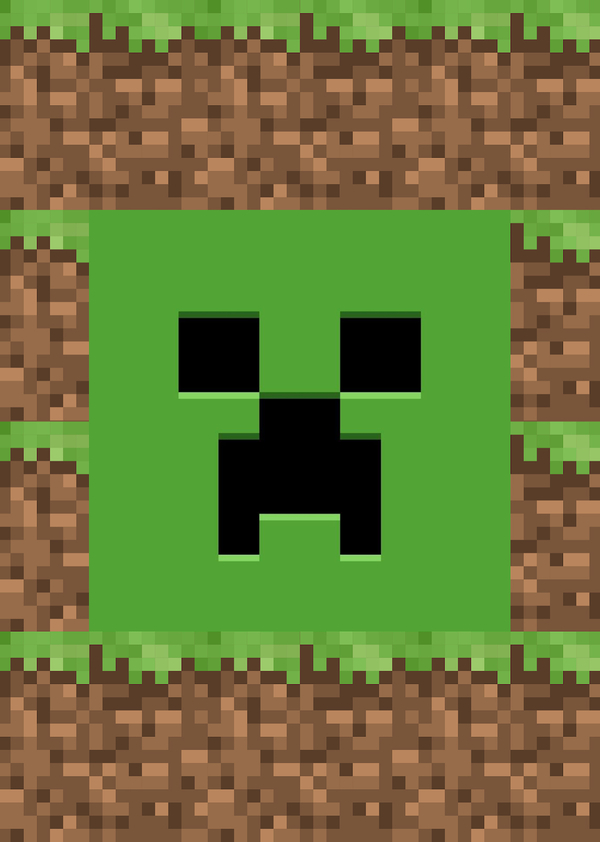
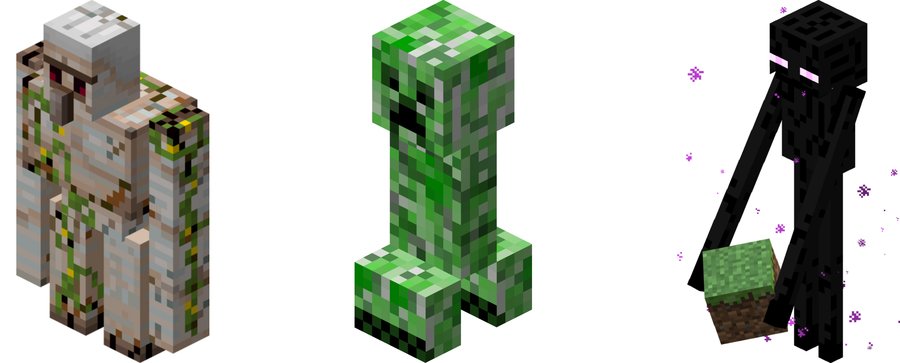
Minecraft, created by Notch and further developed by Mojang Studios, is one of the subsidiaries of Microsoft. Since its first public release in 2011, the game has expanded beyond its niche and turned into an educational tool, an architectural framework, a social network, and a public metaphor. Аll in the defiantly unassuming aesthetic of 16×16 pixel blocks.
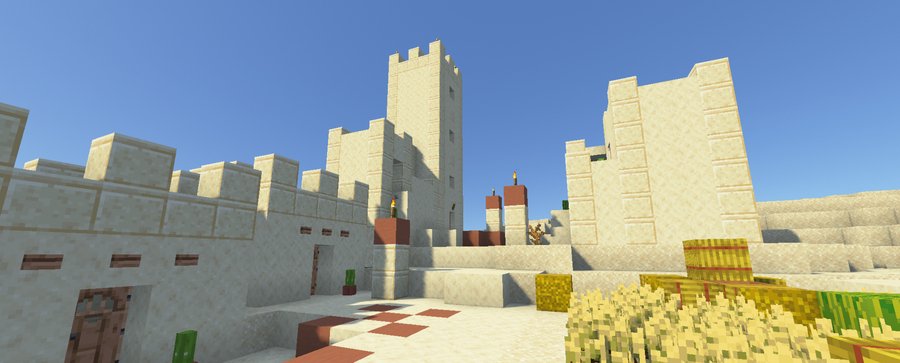
What distinguishes Minecraft from ordinary entertainment products is the radical openness of its concept. There are no mandatory goals, prescribed victory conditions, or the only correct path in the game. The game provides the player with an endless procedurally generated world and three words:
Create. Explore. Survive.
This slogan is the philosophy of the whole brand. The brand positions itself not as a product for consumption, but as an infrastructure for the human imagination.
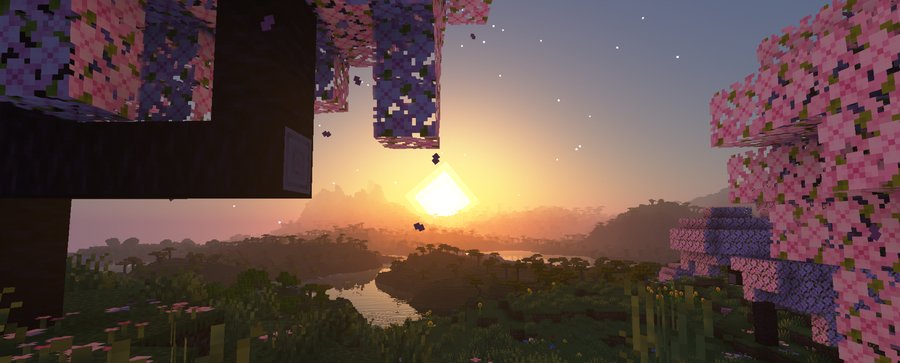
Brand Positioning
Radical Inclusivity
The voxel aesthetic and accessible controls lower barriers to entry for all ages, skill levels, and backgrounds. Everyone can participate.Infinite Agency
No two worlds are the same. Player decisions shape the game. This is positioned as freedom, not gameplay.Timelessness
The deliberately retro, low-fidelity art style makes the product resistant to graphical aging, a deliberate counter-positioning against photorealistic competitors.Community as Core
Minecraft doesn’t merely have a fanbase. It has co-creators. Mods, servers, and fan art are not peripheral, they are central to the brand’s value proposition.Target Audience
One of Minecraft’s most remarkable brand achievements is its multi-generational reach. Phenomenon that is strategically cultivated rather than accidental. The brand operates with two primary, distinct audience segments whose needs and motivations differ substantially:
Primary Segment: Digital Natives (Ages 8–15)
× Engage with the platform primarily for social play, creative expression, and peer bonding through shared servers and builds.
× Highly influenced by YouTube and Twitch content creators such as Dream, Technoblade, and MrBeast, who function as de facto brand ambassadors.
× Attracted to Minecraft’s frequent content updates, new mobs, biomes, and seasonal events that maintain freshness.
× Represent the dominant segment for merchandise purchases, mobile (Bedrock Edition) downloads, and Marketplace content.
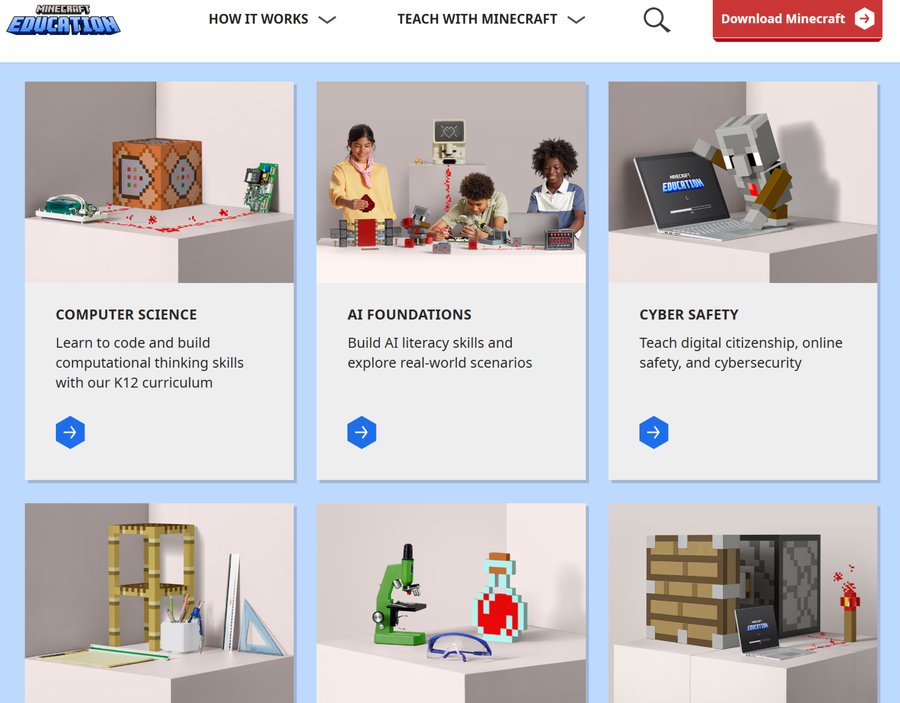
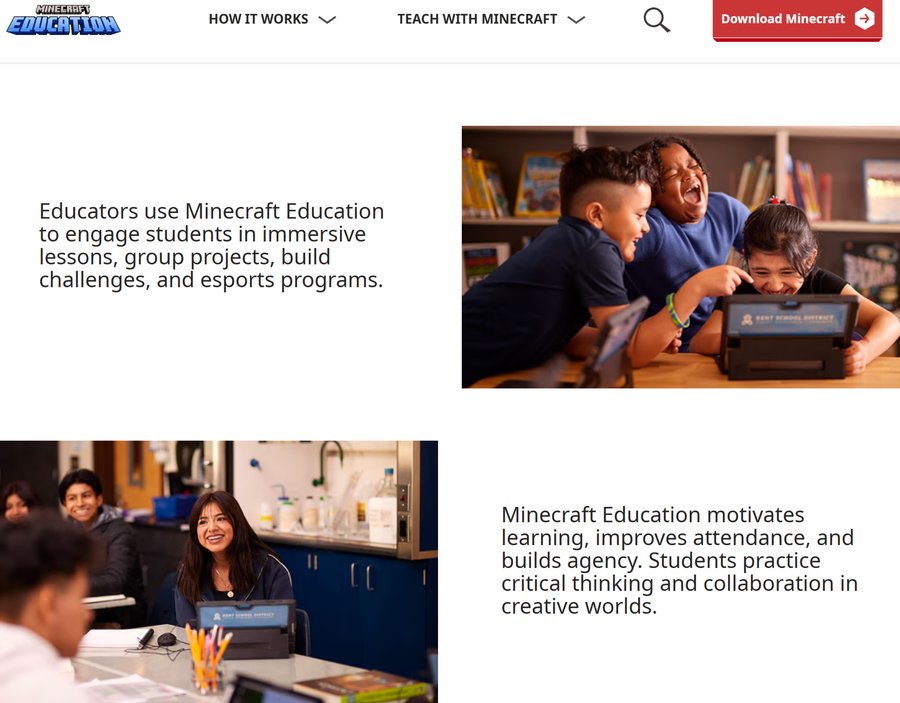
Minecraft Education is an immersive learning platform used by schools worldwide to inspire students, build skills, and encourage creativity, curiosity, and critical thinking.
Secondary Segment: Legacy Players & Creators (Ages 16–35+)
× Treat Minecraft as a sophisticated medium: engineering complex Redstone circuitry equivalent to rudimentary programming, designing large-scale architectural projects, or creating custom game modes.
× Driven by nostalgia, mastery, and community belonging. Many were Primary Segment members who aged with the platform.
× Highly active on Reddit (r/Minecraft, r/feedthebeast), GitHub (modding communities), and Discord servers managing large-scale community servers.
× Their organic content creation on YouTube and social media constitutes Minecraft’s most powerful free marketing channel.
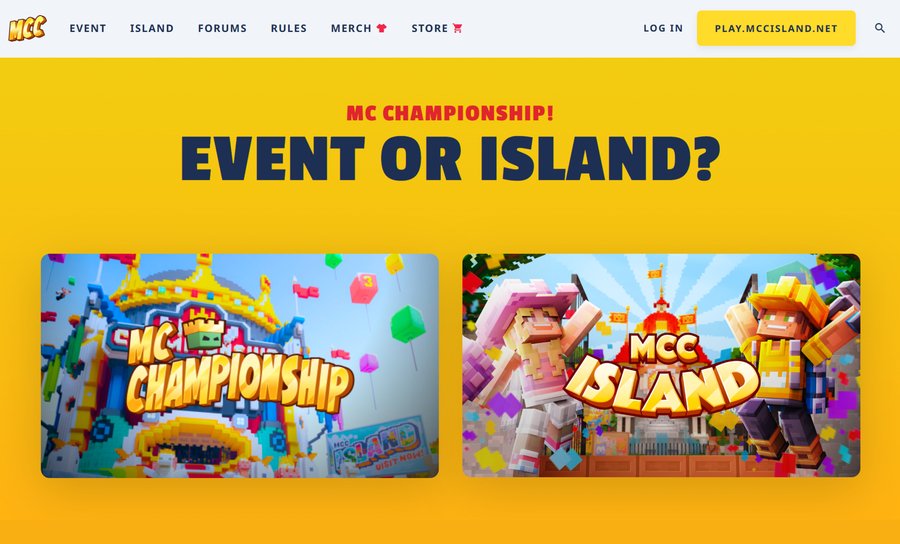
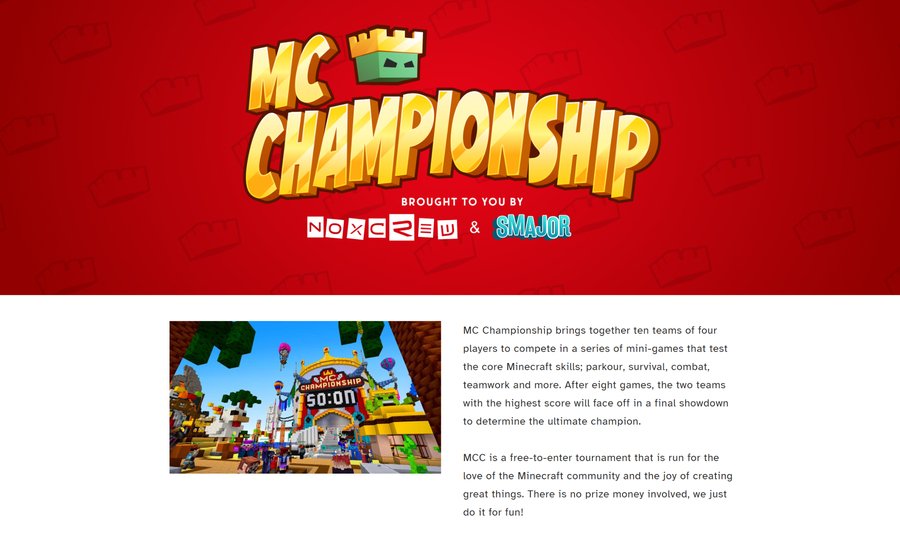
MC Championship (MCC) is a Minecraft YouTuber tournament organized by YouTuber Scott Major and Minecraft collective Noxcrew.
Communication Channels & PR Strategy
Unlike traditional FMCG or entertainment brands that rely on centralized, outbound advertising campaigns, Minecraft operates what communications theorist Henry Jenkins would describe as a transmedia ecosystem — a network of interconnected channels where content flows organically between official and community-generated sources. Mojang invests minimal budget in traditional paid advertising; instead, its PR strategy functions as a sophisticated amplification engine for its own community.
This is a deliberate, evidence-based strategic choice. With over 1.5 billion views of Minecraft-related content generated monthly on YouTube alone, attempting to compete with organic community content through paid media would be both financially inefficient and tonally incongruent with the brand’s collaborative identity.
Digital Channels
YouTube
× High-production trailers and cinematic update reveals (e.g., «Minecraft Live» annual event streams attracting 1–5M concurrent viewers).
× Developer diary series such as «Minecraft Education» and «Minecraft Monthly» satisfy the audience’s appetite for behind-the-scenes transparency.
× Official shorts and highlight reels from community builds generate massive organic reach.
× The channel serves as the brand’s equivalent of a television network: episodic, appointment-based content that rewards subscribers.
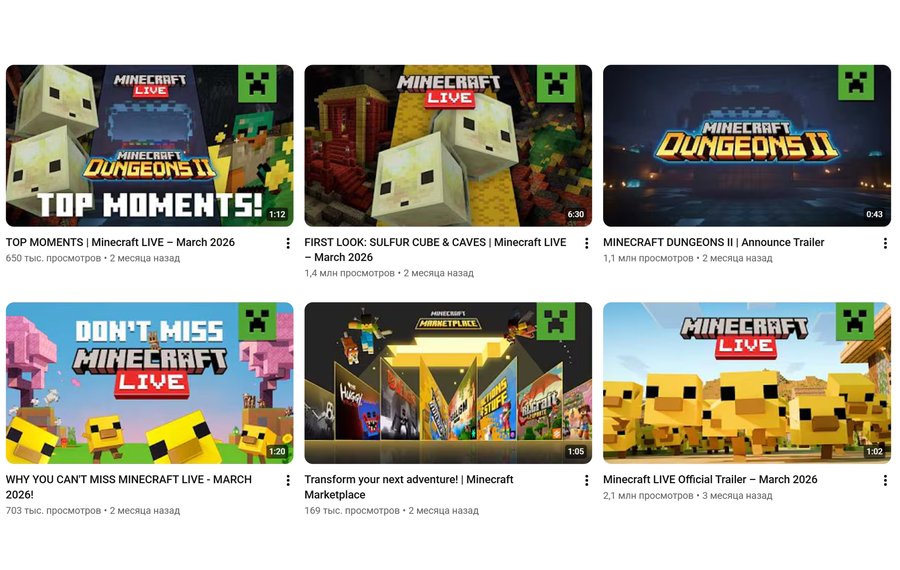
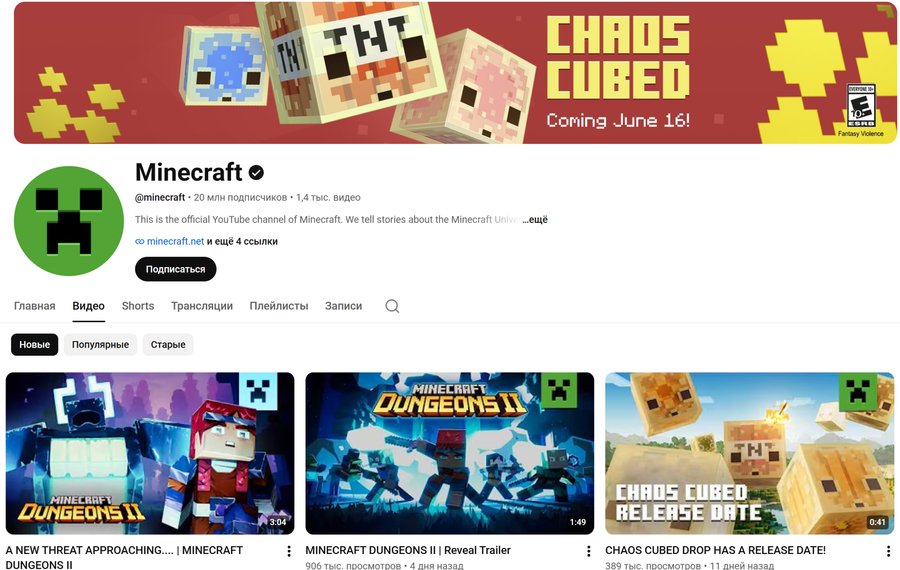
Official Minecraft YouTube channel.
Instagram* and TikTok
× Patch note announcements, seasonal content teasers, and real-time banter with community members and other brand accounts.
× Cross-brand collaboration announcements (LEGO, Crocs, DC, etc.) are maximizing organic media pickup.
× These platforms are often used for advertising campaigns targeting older audiences interested in specific aesthetic preferences and content.
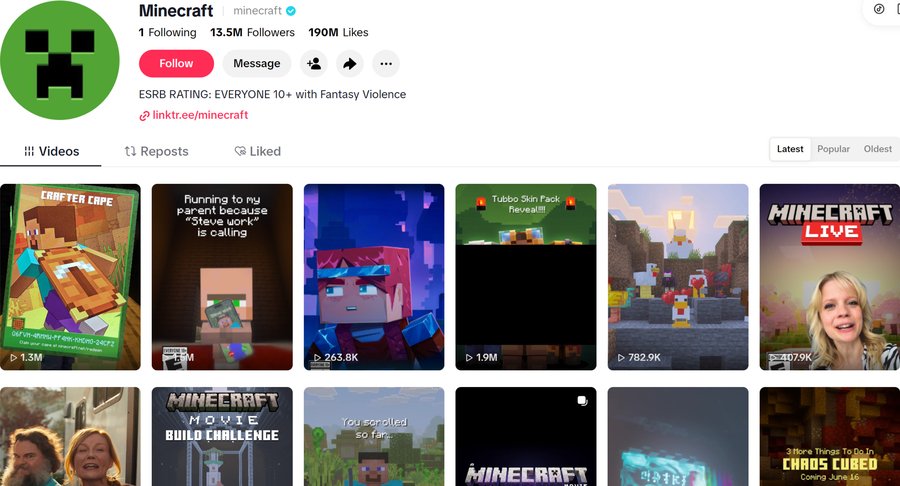
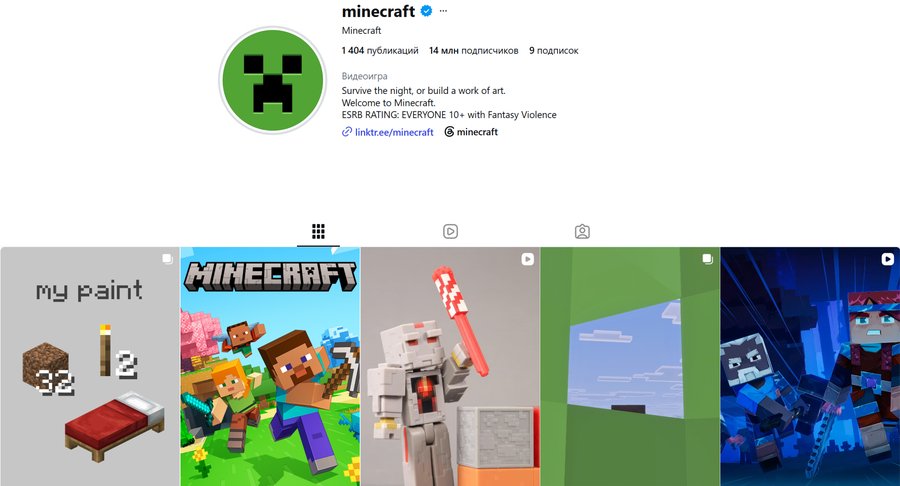
Official Instagram* and TikTok Minecraft accounts.
* Instagram is owned by Meta, a company recognized as an extremist organization and banned in the Russian Federation.
PR Strategies
Minecraft Live: Democratizing the Product Roadmap
Minecraft Live is the brand’s annual flagship interactive event — a hybrid of product launch keynote, community celebration, and democratic referendum. The event includes developer announcements, community build showcases, and most distinctively, the «Mob Vote»: a real-time community ballot where players vote to determine which new creature gets added to the game. This transforms a corporate product decision into a community ritual, generating enormous discourse, fan-made campaign content, and emotional investment months before the event takes place.
Footage from Minecraft Live.
Co-Creation as Marketing Infrastructure
Minecraft actively supports and amplifies the creator economy built around its IP. By providing official modding APIs, the Java Edition open modding ecosystem, and the Marketplace platform for user-generated Bedrock content, Minecraft converts its most passionate players into unpaid (and in some cases, paid) content producers whose work serves as the brand’s most effective advertising. This co-creation strategy generates a self-sustaining promotional engine that no paid advertising budget could replicate.

Official Minecraft DLC Marketplace.
Lifestyle Brand Partnerships
High-profile collaborations with LEGO (a multi-year partnership producing over 50 licensed sets), Crocs, major fashion houses, and entertainment properties (Star Wars, Sonic the Hedgehog, ect.) cement Minecraft’s presence in physical lifestyle spaces and continuously introduce the brand to new audience segments. These partnerships are carefully selected to feel culturally congruent playful, accessible, and creative rather than crass commercial licensing.
The Minecraft section on the official Lego website.
Applying Theoretical Framework
Uses and Gratifications Theory (UGT)
Introduced by Blumer and McQuail, UGT emerged as a corrective to earlier hypodermic needle models of media influence that treated audiences as passive recipients of content. UGT instead posits that audiences are active, goal-directed agents who select and consume media to fulfill specific psychological and social needs.
Cognitive Needs
The desire to acquire information, knowledge, and understanding of the environment.Affective Needs
The desire for emotional, aesthetic, and pleasurable experience.Personal Integrative Needs
The need to reinforce personal identity, credibility, and social status.Social Integrative Needs
The need for social contact, affiliation, and a sense of belonging.Tension Release Needs
The desire for escape, diversion, and relaxation from everyday pressures.Applying Uses and Gratifications Theory
In terms of visuals, particular attention is paid to new gameplay elements: unexplored biomes, new mobs and new tools. All of this helps players realise that new knowledge and skills await them, which they will need to master. The brain perceives unexplored content as a stimulus that triggers cognitive satisfaction.
Vibrant, stylised interface elements, a recognisable pixel art style combined with real photographs, and many other recognisable elements evoke a strong sense of aesthetic pleasure.
In many events and other media initiatives, developers enlist the help of their audience. They run competitions for builders, the results of which see players’ real-life creations featured in the media. In the past, surveys were also conducted on adding new mobs to the game, chosen by the players themselves.
On YouTube, the official channel publishes content that simultaneously caters to the satisfaction profiles of different audience segments. The developers’ videos meet the cognitive needs of the advanced player segment by explaining game architecture decisions, balance changes and design philosophy. Meanwhile, the cinematic trailer satisfies the affective needs of all segments through its impressive visual storytelling. This targeted segmentation of content types ensures that no audience segment feels neglected.
On Instagram* and TikTok, Minecraft’s practice involves weekly publication of various entertaining, informative posts and announcements. The posts invite comments, which strengthen community bonds and generate organic engagement data. This is the UGT feedback loop, in which meeting the audience’s needs stimulates algorithmic amplification on the platform.
The stress-relief aspect of UGT is most clearly realised through Minecraft’s consistent brand tone: carefree, warm, with a light touch of humour, and never corporate. The game and its official communications present themselves as a refuge from life’s complexities. A space where creative play is the sole agenda.
Various posts from official Minecraft accounts.
Dialogic Theory
Proposed by Kent and Taylor, Dialogic Theory challenges the prevailing one-way, asymmetrical model of PR communication and advocates for symmetric, ethical two-way dialogue between organizations and their publics.
Mutuality
An acknowledgment that organizations and their publics are co-dependent stakeholders, not a hierarchy of sender and receiver.Propinquity
Publics are engaged in the present tense. Сommunication is immediate, timely, and responsive rather than scheduled and unilateral.Empathy
A genuine orientation toward listening to and understanding the perspective of the public, even when critical.Risk
Willingness to be transparent and vulnerable, to acknowledge mistakes, debate openly, and change course based on public input.Commitment
A long-term investment in the relationship with the public as an organizational value, not merely as a tactical tool.Applying Dialogic Theory
In the past, Minecraft used a ‘Vote for Mobs’ system, which clearly positioned the player community as partners in decision-making regarding the product’s development plans. For a brand of this scale, it was an unusual move, involving the handover of some creative control. Voting took place in real time during a live stream, with the results announced on air. There was no delay between public opinion and the developers’ response. However, such a system, alas, no longer exists.
Mojang clearly demonstrates empathy by responding to the losing candidates in subsequent development cycles. Several features initially rejected in ‘Mob Votes’ were later added to the game, demonstrating genuine responsiveness to the community’s sentiments.
The bug-reporting community on Discord and Reddit also demonstrates the structural feedback loop of the dialogic model: bugs reported by players are officially acknowledged by Mojang staff, prioritised through community voting, and credited to the players who discovered them in official patch notes. It is also worth noting a dedicated page on the official website, which is specifically designed to gather feedback on all matters relating to the brand. This is a systematic dialogical mechanism that turns the community into quality assurance partners and rewards their participation with status and recognition.
All links to Minecraft resources and platforms, the official support section, complaints and suggestions.
Conclusion & Recommendations
Overall
Minecraft’s communication strategy is exceptional by virtually any measurable metric. Its effectiveness rests on two counter-intuitive insights: the most powerful marketing channel is the audience itself. User-generated content creates billions of monthly impressions at negligible cost; and brand loyalty at scale is built through genuine relationships, not advertising. By applying Dialogic PR principles through Minecraft Live, developer engagement, and structured community feedback, Mojang has created a community emotionally invested in the product’s development.Recommendations
– Redesign the Mob Vote. The current winner-takes-all format generates community fragmentation and brand reputation risk. Shift to a tiered schedule where all three candidates are confirmed additions, with the winner implemented first. — Launch a Technical Content Series. Mature players have unmet cognitive needs. Developer roundtables and architecture deep-dives on topics like procedural generation and Redstone theory would serve this audience while reinforcing Minecraft’s positioning as an engineering platform. — Formalize Creator Partnership Transparency. Over-reliance on influencers creates reputational vulnerability. A public Creator Partnership Framework with clear disclosure norms and creative independence protections would deepen trust.Conclusion
Minecraft is perhaps the most successful case study in community-centric brand communication in digital media history. By treating its audience as co-creators and investing in genuine two-way dialogue, Mojang has built something rarer than market share, it has built a culture.Minecraft Official Site [Электронный ресурс]. — Mojang Studios. — URL: https://www.minecraft.net/en-us (дата обращения: 11.06.2026).
Smart LMS НИУ ВШЭ. [Электронный ресурс]. — НИУ ВШЭ. — URL: https://edu.hse.ru/course/view.php?id=133853 (дата обращения: 11.06.2026).
Русскоязычная Minecraft Wiki — главный источник знаний по вселенной Minecraft [Электронный ресурс]. — URL: https://ru.minecraft.wiki/ (дата обращения: 12.06.2026).
Steadfast / Шейдеры для Майнкрафт / Minecraft Inside [Электронный ресурс]. — URL: https://minecraft-inside.ru/shaders/193101-steadfast.html (дата обращения: 12.06.2026).
Welcome to Minecraft Education [Электронный ресурс]. — Mojang Studios. — URL: https://education.minecraft.net/en-us (дата обращения: 12.06.2026).
Noxcrew | MC Championship [Электронный ресурс]. — Noxcrew Ltd. —URL: https://noxcrew.com/mcc (дата обращения: 12.06.2026).
Minecraft — YouTube [Электронный ресурс]. — YouTube (Google LLC). — URL: https://www.youtube.com/minecraft (дата обращения: 12.06.2026).
Minecraft (@minecraft) — Instagram* [Электронный ресурс]. — Meta Platforms, Inc.* — URL: https://www.instagram.com/minecraft (дата обращения: 12.06.2026).
Minecraft (@minecraft) — TikTok [Электронный ресурс]. — TikTok Ltd. — URL: https://www.tiktok.com/@minecraft (дата обращения: 12.06.2026).
Minecraft Official Site [Электронный ресурс]. — Mojang Studios. — URL: https://www.minecraft.net/en-us (дата обращения: 12.06.2026).
What is LEGO® Minecraft®? | Official LEGO® Shop US [Электронный ресурс]. — LEGO System A/S. — URL: https://www.lego.com/en-us/themes/minecraft/about (дата обращения: 12.06.2026).
Minecraft | Linktree [Электронный ресурс]. — Linktree. —URL: https://linktr.ee/minecraft (дата обращения: 12.06.2026).
Mojang | Linktree [Электронный ресурс]. — Linktree. — URL: https://linktr.ee/mojang (дата обращения: 12.06.2026).