Original size 0x0

Sergey Sapozhnikov. The City

This project is a student project at the School of Design or a research project at the School of Design. This project is not commercial and serves educational purposes

Sergey Sapozhnikov — photographs Vladimir Levashov — texts

From the preface

It all started when Sergey Sapozhnikov and I decided to make an exhibition of his black and white photographs of the city. However, it got off on the wrong foot from the beginning. In general, to whomever Sergey had been showing these photographs, the reaction had been more or less the same wonderment of «what is it?!» For both myself and Sergey, these pictures seemed not only successful, the things we saw in these pictures were so familiar, that we couldn’t understand why no one until today, hadn’t had the idea to just go and photograph all of this. We really wanted to share this private revelation with others.

In the end, we decided that if it was not to be an exhibition, then it would be a book. Sergey proposed to publish it ourselves, with his own money. At this point, it somehow became clear that this book would be much better than an exhibition, at least as a first step. There is a degree of intimacy and personal address to the reader-viewer that cannot be reached in an exhibition. A book, as well as a photograph, is addressed to each person individually, while an exhibition is addressed to everyone as a whole. Besides that, the reader-viewer sees each of the photographs individually, or on a spread paired together with another photograph, which adds, rather than subtracts power to each of them. And only after one has a possibility to live through the personal exceptional contact experience again and again, seeing the whole sequence of images as a whole.

The City’s physical dimensions are based directly upon American Photographs by Walker Evans. This can be seen as a gesture that redeem the whole project from indecently straight dedicating it to the photographer, who feels disgust towards all pathos and everything deliberately artistic.

big
Original size 1276x958

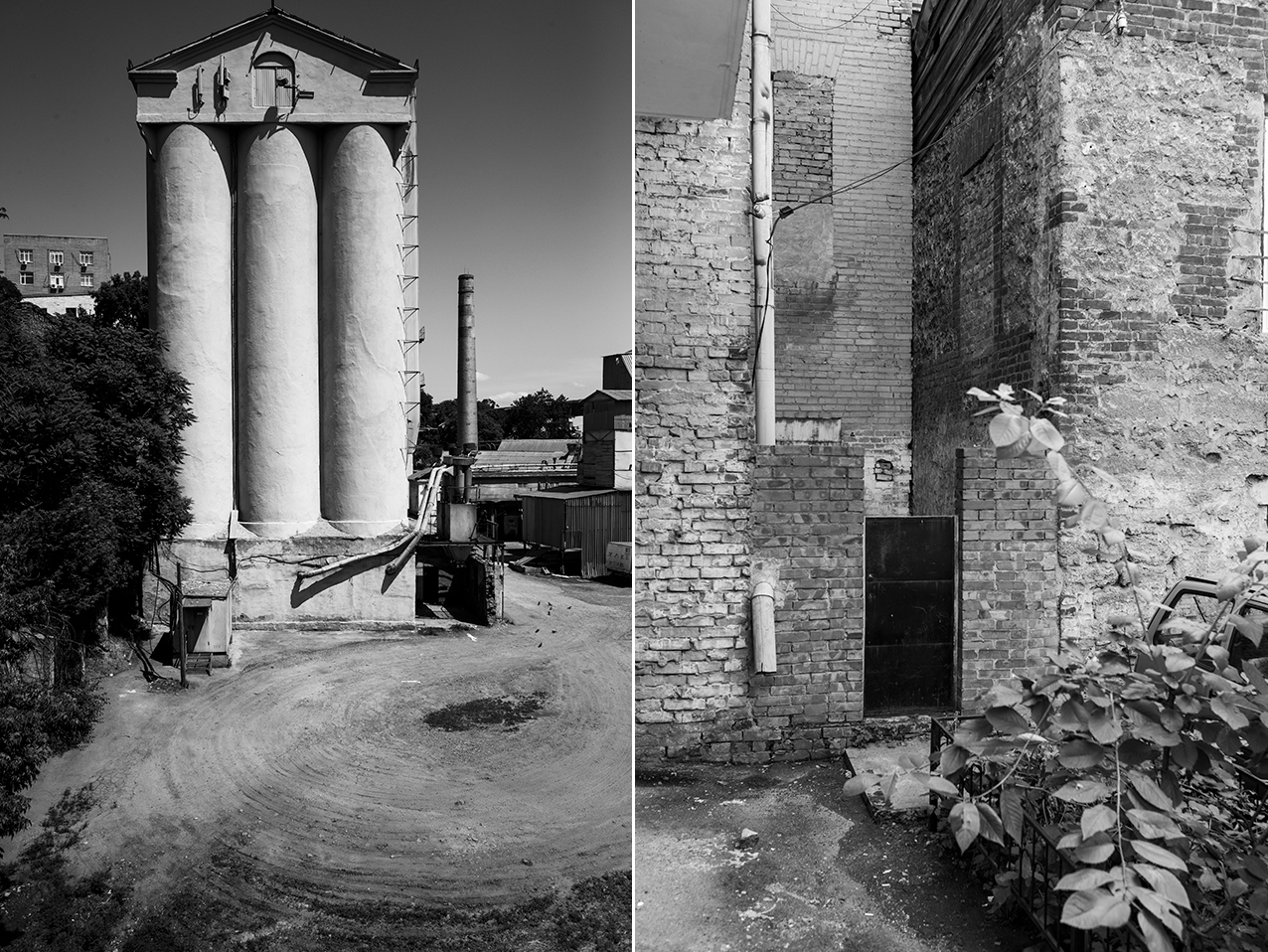
Rostov-on-Don. 2015-2016

The Photographer in the City: Beauty is Life

A couple of years ago, a young photographer from Rostov-on-Don, Sergei Sapozhnikov, began taking black-and-white pictures of the urban environment. The new turn in his work was not an obvious sequel to what he had done previously. Sapozhnikov won recognition for his arranged colour photographs, using extravagant constructions made from the chaos of industrial refuse and household junk, which is the hallmark of Russia’s manmade environment. So the material was similar, but not the approach. Photographing the urban environment quickly became a passion for Sapozhnikov and one that was, as the author says, «ever less connected with contemporary art» or, at least, with the system of norms that goes by that name. The result was a position that is unique for a contemporary artist. On the one hand, a rejection of conceptual foundations for creative practice and a shift to the field of pure photography. On the other hand, the discovery of a visual resource that our country has in abundance, and which hardly anyone finds interesting, unless their job requires them to.

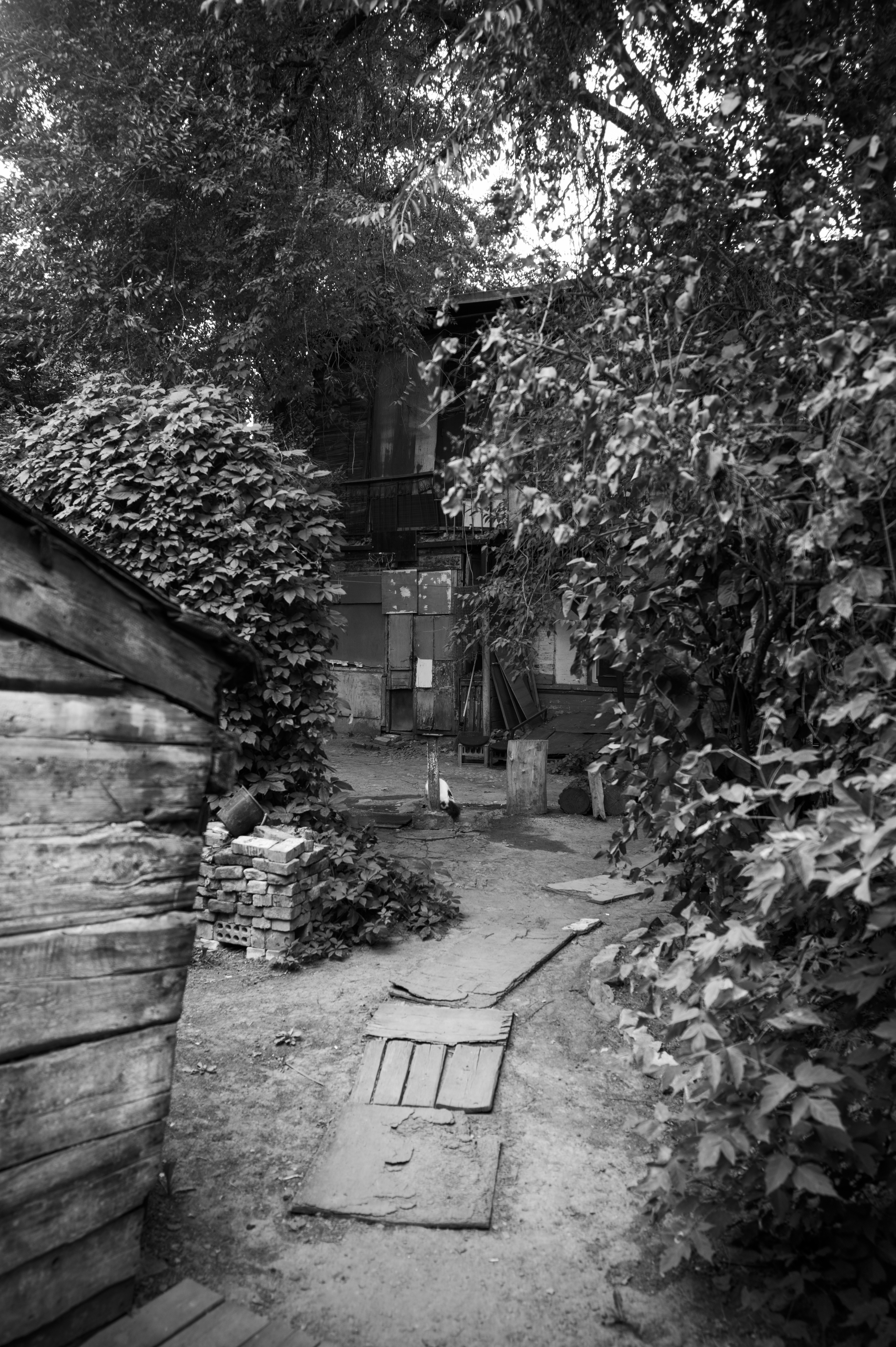
The subject matter is the most mundane and ordinary: buildings devoid of architecture, self-built trash, endlessly refashioned lean-tos, yards and city districts that are alike in their unlikeness. This is the anonymous space inhabited by the greater part of the general public, familiar to the point of automatism and almost unnoticed, used and remembered highly selectively and out of need. It was discovered as a self-sufficient object by Eugène Atget and his surrealist compatriots, but its most consistent, varied and productive treatment was by Americans, starting from Walker Evans. In Russia, until recently, the total ideologization of photography made it unthinkable to direct the camera at such objects. We only have analogues in art, from Mikhail Roginsky to Irina Korina, but they belong to a completely different type of visuality, with a different level of intentionality and degree of expression. It is only now that dispersed islands are starting to emerge, from an ocean of emptiness, in local photography around Russia. Each with its own nature and climate.

Original size 1276x958

Rostov-on-Don. 2015-2016

Sergey Sapozhnikov: «The most difficult and important thing for me was to realize that the urban environment simply is beautiful, and that you don’t need any special reasons for photographing it. This approach is very close to American photography. I was attracted by that photography and I wanted to take a break from intellectual, project-based work, so I got to walking about my native city in search of something interesting. At first, I couldn’t find any interest or beauty in the ordinary environment, I was on the look out for architectural monuments. And it took a while before I realized that the subject itself is not so important, the main thing to free your mind, relax and take pleasure. Now it has become a way of life. I can’t explain it. I don’t feel any urge to explain it.» The main point here is the assertion of direct photography of the urban environment as a holistic, energy-efficient (recreational) activity, an alternative to contemporary art as an activity that is a fragmentary, specialized (mental) and energy-intensive. Or, what is the same thing, a contrast between a conceptual project and the search for beauty. Specifically, the ordinary urban environment itself is called «beautiful» and its beauty justifies the photography, so that no other justifications are needed. Certainly none of the justifications that might be called a «concept», dictating the form and meaning of the final object, elevating it to the status of a project, and abolishing the concept of beauty as a modernist fiction. So the very presence in the artist’s lexicon of the word «beauty» signals a break with a critical-analytical type of art and a return to formal values. In other words, to the self-referential form, which is strong in itself, without the prosthesis of a concept, and which produces an effect that perceivers call beauty. Obtaining such an effect by the use of some natural material always was the goal of art. Or rather its project, until the latter recently disintegrated into a multitude of narrowly specialized projects, defined by a concept instead of a form adequate in itself.

Original size 1276x958

Rostov-on-Don. 2015-2016

Beauty is revealed to Sapozhnikov, not in exceptional architectural monuments (beautiful in themselves) but unexpectedly, in the banal human anthill, in what would not attract the attention of its inhabitants any more than that of the «normal» photographer, whose eye is caught by what stands out from the level of ordinariness or collects the ordinary in order to create a typological series, from which a rule is derived and a language formed. «Normal» attention focuses on what has already been quantified, processed, completed and made into a formula or will ultimately be made into a formula. It is attention that remains within the bounds of logocentrism. Unexpected beauty, on the contrary, is an unprogrammable contingency, something that can only be stumbled upon in the chaos of the ordinary, effaced and unnoticed. Such contingency is the the best trophy of street photography, which broke off from the pragmatic photo-documentary genre under the influence of the surrealists, who had taken Lautréamont’s line, «as beautiful as the chance encounter between a sewing machine and an umbrella on an operating table», to be their motto. André Breton and his fellows sought out such singular combinations on flea markets, and the street photographers took the search to the entire human habitat. The photographers of man-altered landscape did something similar. But what the former always had in their frame was people, snapped «on the fly», while the second were interested in the urban environment as such, captured using large-format cameras. The first were looking for events, the second for objects. Sapozhnikov’s shots of the city show us a union and reworking of the techniques used by these two groups of photographers. He captures an unpopulated architectural environment, but does it off-hand, using a monochrome digital Leica, imitating the typical street photographer in pursuit of «the event», «the decisive moment» that requires instant reaction. Such a picture of the moment has to be as sharp (digital technique) and structurally clear (black-and-white image) as possible. But instead of — or rather, in the role of — an event, Sapozhnikov’s frame always captures a single object. Not, however, an object that is separate, but one that has grown into its own system of surroundings, or this system of surroundings itself as a composite object.

Original size 1276x958

Rostov-on-Don. 2015-2016

Accordingly, his frame is usually vertical, excising the object from the city’s horizontality in order (as he says) to «minimize the field of view, to make us look, not at everything at once, but at something very concrete and interesting in itself.» This vertical format is determined by the stance of the photographer, by his intention and attitude. In a 2005 interview with Vicki Goldberg, Thomas Ruff discussed the Stars project, in which he used photos purchased from an observatory. Ruff said that he had to choose between vertical and horizontal exposition of the image fragments. «The first images I displayed in my studio horizontally, but it wasn’t satisfying. The horizontal format is a window, but the images I had in mind weren’t a window. I wanted the door, suggesting, ‘Put on a helmet, go out into space, become a Captain Kirk.’ That’s why I made them vertical…» Ruff’s motivation for his choice of format is almost like that of Sapozhnikov. But Ruff’s project is based on an uncompromising concept, generating the symbolic figure of an active viewer and a series of fragments of an equally symbolic infinity. The Russian has a quite different and definite «cosmos». Instead of a photographic ready-made, he has documentary evidence of direct contact with such a cosmos: as Roland Barthes would say, it «was» and wasn’t merely made up. But the «door» format is only a precondition for actually going out. In order for the roving eye to take that step within the image, the image must have a certain intra-frame composition. This composition is the ultimate realization of «the incredible potential of the combination of details» (Thomas Struth), a combination selected by the photographer from the natural material. At the same time, it is a space for the movement of our gaze, which, in turn, is a continuation of the movement of the photographer up to the moment when he clicked the shutter. This involves entering into the frame and its depth rather than moving alongside it and across its surface. It is not an instantaneous capture of the image, but takes time to achieve. When he started to take an interest in the city, Sapozhnikov shot street photography with people and microevents, where, he says, «it is important to show all the surroundings and to show them from different angles.»

Original size 1276x958

Rostov-on-Don. 2015-2016

Each of the pictures recorded an instantaneous event, a fragment of the city’s overall movement, and therefore inevitably entailed a whole series of images connected with each other and having something like a narrative plot. At least, this series included the plot of the performance, in which the photographs were takenAnd then later the self-sufficient (plotless) single frame, removed in principle from the trajectory of the performance of its creation, became the goal. Preserved in the uncompromising static, which, by saying nothing of the performance of the photographer, is precisely the condition of the viewer’s independent movement within the image. Or, as put by Sapozhnikov: «Then I departed completely from ‘of-the-moment’ street photography and created a self-sufficient image — boring and without development. <…> I, as it were, stopped creating a situation, where I would just happen to be on hand. I got carried away by reality, imagining that I was not there.» Of course, this static of the image is a function of a definite composition of the picture, which in turn depends on the size of the object in the frame and the angle. The static is maximized by a «classic» composition with a strictly horizontal horizon and the object in the centre of the frame, i.e. situated directly in front of the photographer in the middle distance. Such composition gives a clear vertical division of the image plane into three zones: the foreground in the lower part, the object in the middle and the space above it in the upper part. For all the variety of Sapozhnikov’s images (the object may be further away and therefore shift into the upper zone, or may be enlarged and occupy the upper two-thirds or even the whole image), they all contain this composition as invariant. It provides the spatial zoning that most favours a virtual journey through the image. The empty foreground opens to the gaze, and gestures the way to the central object, which is the main event, the culmination of the eye’s journey. The overall drama of the image, its movement depends on the arrangement of the zone occupied by the object, on all the components that form the object and on their links with everything that is in front of and behind it.

Original size 1276x958

Rostov-on-Don. 2015-2016

The movement ends in the space behind the object, which sets the potential extent and prospective vector of travel, performing almost the same role as the space outside the frame in a photograph that uses a highly fragmented and (or) horizontal composition with its own intra-frame movement. The drama of Sapozhnikov’s images lies in a dialectic of openness (invitation) and closedness (resistance) to our movement through it, and in the rhythmic variety, which is precisely what holds our interest when we look at the thematically tedious photographs. In some of them, representing a single building at a certain distance, there is a quiet acceptance of our attention as our gaze wraps around the object and rolls on further, to be involuntarily dissolved beyond it. In others our gaze falls into a shaft or passage between walls, fences and debris, leading finally to an unequivocal dead-end, or we find the relief of an archway, an outflow through glass or a turn towards light that beckons from around a corner. But we can be satisfied with somnambulistic wandering around some haphazardly heaped-up edifice or within the confines of a yard, turned by the daily grind of work and life into yet another masterpiece, of which its inhabitants are quite unaware. Viewing these photos is always an adventure, full of incidents and accidents, like any adventure. And because the photos reveal a materialization of the collective unconscious in an environment that has accrued chaotically, it can be said that this environment consists entirely of contingencies — with their sudden beauty. Certainly, it takes a special inclination refined into a skill in order to see it. People who are free of such an inclination will take Sapozhnikov’s images to be muck-raking, an intentional representation of the poverty and ugliness of ordinary life. But, for me, the poverty and ugliness of Sapozhnikov’s «Russian favela» are the best premise of photographic beauty. Direct, documentary photography is, of course, a mirror of reality, but that does not mean that it can abuse its ability for visual simulation with impunity, through parasitism on domains that do not belong to it. To photograph what is already beautiful, an environment arranged in accordance with enlightened reason (beautiful cities, nature «ennobled» by human intervention, etc.) is to use a poor resource, to process a semi-product.

Original size 1273x958

Rostov-on-Don. 2015-2016

The initial selection from Struth’s «incredible potential of the combination of details» has already been carried out by the architect, landscaper, or somebody else, and the resource left over for the photographer is less than the original, which was natural and chaotic, randomly generated, unconsciously produced. A fine example of such an original resource is that landscape altered by man, from which American photography has produced such a wealth of first-class aesthetic product. In its Russian version it has been dubbed by Ilya Kabakov, snobbishly but appropriately, «stroika-pomoika» («trash-build»). It is a spontaneously arising human environment, where the formative powers are material degradation and a contradictory and disorderly effort to overcome that degradation. Such effort is the antithesis of conscious renovation (oriented to the future) and restoration (conservation of the past). This type of human environment is a direct analogue of the natural environment with its mutually convertible processes of growth and decay. And, like the natural world, it lives as a single organism, where the action of time is not a confrontation of past and present, but a factor of the continuous transformation of matter and the growth of information density. «You don’t have to go looking for pictures. The material is generous. You go out and the pictures are staring at you» (Lee Friedlander). The photographer captures them, over and over again, taking his choice from the continuous flow of his surroundings. What, in fact, does he choose, when he transforms something into a picture? What looks interesting, what appears beautiful. What is interesting in the surrounding world is anticipated as beautiful in the photos, so the interesting and the beautiful are often synonyms in the photographer’s practice. The interesting-beautiful is almost the sole criterion for the selection of images by a photographer, to whom the real subject is more important than his own ideas about his surroundings.

Original size 1276x958

Ростов-на-Дону. 2015-2016

However, since the beautiful in a photograph is formed from what is merely interesting in the surrounding world, it eludes definition in principle as a characteristic of the urban (plain, ordinary) environment. Hence a feeling that it is «not there at all, all there is are opportunities to share your view and your attitude» (Sapozhnikov). And if you still want to define what is beautiful in the picture, this can only be done indirectly, through the instrumental conditions of its origin. Accordingly (Sapozhnikov again), «beauty is when everything it in its place, when there are no excesses or vulgarity» and the word «beauty» is a substitute for «expressive proportions», «lack of distortion», «clarity of perspective» and «formation of distance». The issue in each of these definitions is the choice of a photographic optic, which is as close as possible to that of the naked eye and gives, as it were, a natural picture, which the viewer can enter into. It is also the excision of everything superfluous: absence of colour, so that the surroundings «lose their first (ordinary) impression»^; vertical composition, cleansing the image of extraneous subjects^; absence of people, so that only «what they have done, built on or abandoned» is present. The outcome of this sublimation of the image, the ideal behaviour on the part of the photographer, would be, as Sapozhnikov puts it, «not to touch anything and not to spoil anything in the frame» so that the image is, «not what I meant, but what exists without me, without my interference». Or, as Friedlander formulated this same model of direct photography: «The world creates my pictures, and not me.» All this fits perfectly with the simple formula of the Russian 19th century critic, Nikolai Chernyshevsky, «Beauty is life», but with the single, significant difference that what is at issue in our case is life corrected by the photograph, the photographed world (Garry Winogrand). In other words, it is life that is somehow made beautiful precisely in the photograph, and it is beauty that the photographer somehow senses in the ugly material of life when he finds it to be interesting. And the viewer — in reverse order — sees life as beautiful thanks to the photograph, as a result of which interest awakens in him and incites him to «enter into» the photographic image.

Original size 1276x958

Samara. 2015

The photograph is taken by us to be a transparent medium, merging with the object that it depicts, and its correction of life is utterly different from any kind of «realism» in hand-made art. Most of all because the photograph (particularly the direct, documentary photograph) cannot help but show only a single fragment of the outside world. This is not the case in hand-made fine art. Certainly, here also we see a fragment, but one that has been synthesized from many fragments into something typical, which programmatically, metonymically represents the whole, a full mental and then visual picture of the world. Of course, such an assertion oversimplifies the givens of art and, for example, a life study is infinitely more fragmentary than the picture, for which it serves as preparatory material. Many hand-made images created since the invention of photography and influenced by it, as well as many staged photographs also use fragments to achieve a certain «wholeness». But this does not detract from our point. The painting (as the most precise symbol of traditional art) removes all the particularities, which are not related to such ideal wholeness, to the idea of the painting, while direct photography, on the contrary, preserves and impartially documents. And it thereby testifies dialectically both to its own fragmentariness, and to its belonging as a fragment to the whole that it does not encompass. A real whole, as opposed to the ideal, other-world («cult» as Walter Benjamin would say) whole of the painting.

Original size 1276x958

Vladivostok. 2016

Beauty, the beautiful are ultimately harnessed to what is whole and complete, to a speculative totality, so the documentary visual fragment, strictly speaking, should not be beautiful. For this reason, also, the photograph is most natural, varied and, so to speak, most photographic, most true to its authentic aesthetic when it depicts what is objectively lacking in attractive qualities. But, of course, it is true only potentially, and the task remains, if we are talking about creative direct photography, of realizing this potential, of transforming the multiple, fragmented, chaotic and contingent objectivity of the world into the picture-genus, the totality of the abstracted form of an artistic image, without losing the sense of life, without cleansing it of the details of photographic representation in order to obtain a consistent formal structure. This happens when the photographer is able to simply see in his surroundings «the pictures staring at him» and to capture them, thereby putting a real fragment into an abstract formal design, lending fullness and beauty to the fragment, beauty that seems to be created just for him, that has grown from his visual texture. This, in a word, is the miracle of photography, approximated most economically by Sergei Sapozhnikov’s formula: without arrangement, expressive colour, extreme angles or performances. This is the «most simple and most accurate recording», which makes the link between beauty and life.

Image sources
1.

Сергей Сапожников. Город /Sergey Sapozhnikov. The City. Ростов-на-Дону / Rjstov-on-Don, 2016

We use cookies to improve the operation of the website and to enhance its usability. More detailed information on the use of cookies can be fo...
Show more