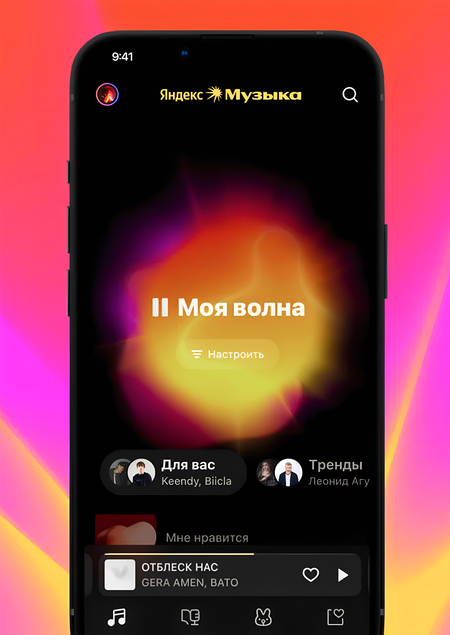
Brand overview
Yandex Music is a popular music streaming service developed by Yandex, one of Russia’s largest technology companies. The platform provides access to a vast library of licensed tracks, podcasts, and audiobooks, and is available both as a web version and as a mobile application for iOS and Android. The service operates on a subscription model as part of the unified Yandex Plus subscription, which unlocks a range of benefits including ad-free listening, maximum audio quality, and the ability to download content for offline use (1).
Core positioning
Yandex Music has evolved from a conventional streaming platform with a catalogue into what it describes as a personalised recommendation ecosystem. Its positioning is built around the concept of a «smart» assistant that anticipates the listener’s preferences rather than simply offering a library to browse (2). This shift is reflected in three key pillars.
First, AI-powered recommendations through its flagship feature «My Wave», which analyses contextual factors such as time of day and playback device to adapt to the user’s current mood in real time (3).
Second, deep integration with the Yandex Plus ecosystem, making the music service part of a seamless user experience that also includes streaming video, books, and cashback rewards.
Third, support for the music industry — the platform positions itself as a space for artists, offering independent musicians tools for pitching new releases and reaching audiences through built-in algorithmic promotion (2).
Target audience
Yandex Music’s monthly active audience exceeds 30.5 million users. The core demographic is adults between 18 and 45 years old, with a strong representation of economically active listeners. Geographically, the platform’s primary reach is Russia and the CIS countries, with approximately 90% of users accessing the service via mobile applications (4). In terms of content consumption behaviour, the «My Wave» algorithm plays a central role — it accounts for roughly half of all music added to users' personal collections, indicating a high level of trust in algorithmic recommendations among the platform’s audience (4) (5).
Communication ecosystem and PR-campaigns
Yandex Music leverages a comprehensive communication ecosystem to engage with its audience. Key channels include in-app push notifications, personalized email campaigns, promotional banners, and Instagram-style in-app Stories, alongside a dedicated support chat. For creators, the platform offers the Yandex Music for Artists dashboard, BandLink integration, and targeted social media channels.The platform maintains an active presence on VK and Telegram, where content is largely mirrored, as well as an official blog on Yandex Dzen. All social media efforts are strategically focused on promoting new releases and sharing exclusive industry insights.
Yandex Music’s core PR strategies are centered on driving user acquisition. The platform heavily collaborates with artists, who promote their tracks by encouraging fans to listen to them exclusively on Yandex Music. Additionally, the service leverages cross-promotion through targeted ads across all other Yandex ecosystem apps. Beyond digital marketing, the platform actively utilizes offline channels. Massive billboards advertising new releases or concert tickets for popular artists can frequently be seen in Moscow and other major cities. Yandex Music also enhances its brand presence by sponsoring numerous music festivals and youth-oriented events.
Theoretical framework
For our analysis of the Yandex Music brand we used the «Uses and Gratifications Theory» and the «Elaboration Likelihood Model» (ELM)
Uses and Gratifications theory views the audience as an active participant in the communication process and explains the needs users satisfy through the service. In the case of Yandex Music, these needs include entertainment, self-expression, developing a personal identity, gaining new experiences and maintaining social connections through music and playlists.
The Elaboration Likelihood Model helped us understand how brand communications shape users' attitudes toward the service. Users can make subscription decisions through a central information processing pathway, evaluating platform functionality and subscription benefits, or through a peripheral pathway, focusing on brand awareness, advertising, recommendations from friends, or collaborations with popular artists.
Analysis
Personalization as identity construction
It is especially noticeable that Yandex Music’s core communication strategy relies heavily on personalization. The platform creates customized recommendations based on listening history. This dynamic aligns with the «Uses and Gratification Theory». For today’s listeners, musical tastes aren’t passive choices; they’re active tools for projecting values and emotional states. Every time users like a track, skip a recommendation, or create a playlist, they provide signals about their preferences and self-expression.
Features like the algorithmic «My Wave» or the personal AI companion «Lumen» reinforce this effect, emphasizing the individuality of content. Furthermore, the uniqueness of each user is particularly evident during the platform’s annual end-of-year reviews. By packaging data in stylized infographics, Yandex Music encourages users to share their final results on social media and discuss them with friends.
From an ELM perspective, this deep personalization functions as a powerful persuasive tool. Because the system’s recommendations are clearly linked to the user’s past actions, they serve as logical arguments. If users feel that recommendations match their preferences, they are more likely to trust the platform.
Mood-Based Communication and Emotional Regulation
The platform actively makes a set of music based on emotions. The application features a wide array of playlists categorized by immediate affective states or daily routines, such as «Energetic», «Joyful», «On the Road» or «Waking Up.»
Such playlists seem to help users manage their mood and choose music according to their current emotional state. Users navigate these categories based on their immediate emotional goals (like looking for relaxation) rather than searching by traditional genre labels.
Presented categories are so effective because they activate the peripheral pathway (ELM). Users seeking a quick mood boost rarely analyze tracklists or artist biographies. Instead, minimalist emotional tags act as immediate cues, prompting instant selection.
Discovery and information seeking
For variety, Yandex Music organizes search through dedicated sections like «Premieres», «Deja vu» and real-time charts. Moreover, you can visit the section with concerts of your favorite artists. These features satisfy surveillance needs. Users seek information about current music trends and popular artists.
At the same time, the structured presentation of recommendations supports central-route processing within ELM. Users who are interested in music actively evaluate new content, compare artists, and make deliberate listening decisions. And the platform supports such a deep engagement.
Community building through social media
During our research we noticed that Yandex Music actively uses social media, particularly Telegram, to drive engagement through surveys and discussions. Within «Uses and Gratifications Theory» this dynamic fulfills the need for social integration. Even if subscribers rarely interact directly with each other, participating in the same comment sections creates a sense of belonging to a music community.
Telegram posts
Telegram posts
From an ELM perspective, this interaction outside the app involves peripheral information processing, specifically social proof. Thousands of emoji reactions and active comments under a post serve as instant signals of importance to the user.
Artist-centered communication
Telegram posts
The platform undoubtedly relies heavily on artists, prioritizing personalities, but Telegram manifests this in a different way: through informal «circles» recorded by artists for the audience. This format satisfies the user’s desire for parasocial interaction and a sense of authenticity within the «Uses and Gratifications Theory». This allows fans to feel closer to their favorite musicians.
Telegram posts
In terms of ELM, artists themselves become peripheral cues because users already have positive attitudes toward them. When a respected artist directly addresses the audience in an informal video format, positive emotions felt toward the artist are transferred to the platform itself, as people trust the familiar face conveying the message.
Conclusion
Overall, based on our analysis, Yandex Music’s communication strategy appears to be effective in maintaining user engagement through personalization, emotional communication, artist-centred content and community interaction.
The platform successfully addresses several audience needs identified by the «Uses and Gratifications Theory», including entertainment, identity construction, information seeking, emotional regulation, and social integration. At the same time, its communication combines both central and peripheral routes of persuasion described by the «Elaboration Likelihood Model».
However, different users may value different aspects of the service and some communication formats, particularly artist-centred content, may not appeal equally to all audience segments. Therefore, we think that Yandex Music should continue balancing its communication between music discovery, emotional engagement, community interaction and artist promotion in order to maintain relevance for a broad user base.
Yandex Support — Why is Yandex Music paid / Почему Яндекс Музыка платная / https://yandex.ru/support/music/ru/access-and-account/why-is-paid
Forbes Russia — Head of Yandex Music to Forbes: «We are no longer a utilitarian service with a catalogue» / Руководитель Яндекс Музыки — Forbes: «Мы больше не утилитарный сервис с каталогом» / https://www.forbes.ru/tekhnologii/501556-rukovoditel-andeks-muzyki-forbes-my-bol-se-ne-utilitarnyj-servis-s-katalogom
Yandex Company News — Association of the Music Industry and Yandex Music propose content placement guidelines / АМИ и Яндекс Музыка предлагают рекомендации по размещению контента (07.07.2023) / https://yandex.ru/company/news/07-07-23
Sostav.ru — Yandex Music monthly audience exceeds 30.5 million / Аудитория Яндекс Музыки превысила 30,5 млн человек в месяц / https://www.sostav.ru/publication/auditoriya-yandeks-muzyki-prevysila-30-5-mln-chelovek-v-mesyats-79308.html
Dzen — My Wave: audience behaviour analysis / Моя волна: анализ поведения аудитории / https://dzen.ru/a/ZOY5ZPZfTzB5f1Eu
Telegram — Official Yandex Music channel / Официальный Telegram-канал Яндекс Музыки / https://t.me/yandexmusic_live
Yandex Company News — Lumens on Yandex Music will turn text queries into 'My Wave' recommendations / Люмены в Яндекс Музыке превратят текстовые запросы в рекомендации «Моей волны» / https://yandex.ru/company/news/04-06-2026-01