
Original size 2100x2800

A Dream of the Celestial Empire: Chinoiserie from Boucher to Yuxing Chen

This project is a student project at the School of Design or a research project at the School of Design. This project is not commercial and serves educational purposes
The project is taking part in the competition

Concept

Chinoiserie is one of the most paradoxical phenomena in art history. For centuries, Europe created an image of China that did not actually exist: pagodas, dragons, porcelain emperors, and girls in robes under willow trees. All of this was a beautiful fiction, a backdrop for aristocratic pleasures. And I have always been fascinated by this ability of artists to invent entire countries.

But the longer I looked at these pastoral scenes with Chinese umbrellas and Meissen teapots, the more I became interested in another question: what did the Chinese themselves think about this? How did they perceive this European obsession with the «Oriental»? And what happens when they themselves begin to use the very same techniques — but no longer to admire, but to criticize?

How has the visual image of China in European Chinoiserie been transformed throughout the 18th–21st centuries, and in what way have Chinese artists of different eras responded to this tradition — from imitation to decolonial deconstruction?

These questions became the starting point for me. My research is dedicated to the evolution of Chinoiserie from the 18th century to the present day, but not as a mere history of style, but as a dialogue. Europeans constructed a myth of «Chineseness»; the Chinese at first played along in export paintings, and then, especially in the 21st century, reclaimed this language and subverted it.

My hypothesis is that Chinoiserie has traveled a path from the naive exoticism of the 18th century and the Orientalist cliché of the 19th century to a modernist synthesis in the 20th century, where Chinese artists reimagined the Western gaze to search for their own identity. In the 21st century, they move towards conscious deconstruction, transforming Chinoiserie from a European fantasy into a tool for decolonial critique and an ironic analysis of global culture.

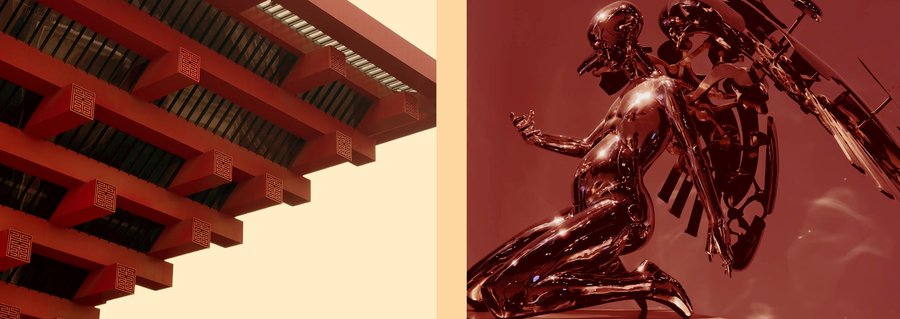
Original size 3500x1240

China Art Museum, Shanghai, personal archive

In selecting materials, I was guided by clear criteria. The research includes only those works that contain direct visual markers of Chinoiserie: pagodas, dragons, screens, «Sinicized» figures, porcelain with relevant scenes, willow and flower patterns, and more. I deliberately exclude general Orientalism (Middle Eastern or Japanese motifs), as well as traditional Chinese painting that has not entered into a dialogue with the European style. The genres I ultimately selected are: painting, graphics, furniture, architecture, porcelain, as well as photographs of installations and video art.

A unique feature of my approach is the parallel presentation of both sides: the European myth-makers and the Chinese artists who responded to this myth at different stages. For the 18th–19th centuries, these are masters of export art and the «counter-style» (occidenterie). For the 20th century, I chose Chinese artists who studied in Europe and synthesized traditions with modernism. For the 21st century, the focus is on authors working with installations and media, for whom Chinoiserie becomes a method of decolonial revision.

Original size 3500x1240

Art Zone 798, Beijing, personal archive

To understand what materials I needed for my research, I first traveled to see them in person. I visited the China Art Museum in Shanghai and then went to the 798 Art Zone in Beijing, whose website I also used to collect contemporary art materials. Additionally, I worked with the online collections of major museums (the Louvre, the Freer Gallery of Art), websites of contemporary galleries (Long March, Ullens Center), and catalogs of recent exhibitions. The theoretical framework is based on studies of Chinoiserie history, Edward Said’s works on Orientalism, and articles and interviews with contemporary artists.

Structure:

Chapter 1. Constructing the Myth: European Chinoiserie and the Chinese «Headwind» (18th–19th centuries)

Chapter 2. The Turning Point. The 20th Century: Transformation of Tradition in the Mirror of Western Modernism

Chapter 3. «The Other’s Response»: Decolonial Revision of Chinoiserie (21st century)

The principle of categorization is based on a chronological method combined with a cross-analysis of European and Chinese visual lines. The research traces the path from the formation of the myth (18th century) through its modernist transformation (20th century) to a conscious postmodern revision (21st century). Each chapter is built on the principle of dialogue: from the Western impulse to the responsive gesture of Chinese culture, allowing us to see art history not as a one-sided influence, but as a complex process of mutual reflection.

Chapter 1. Constructing the Myth

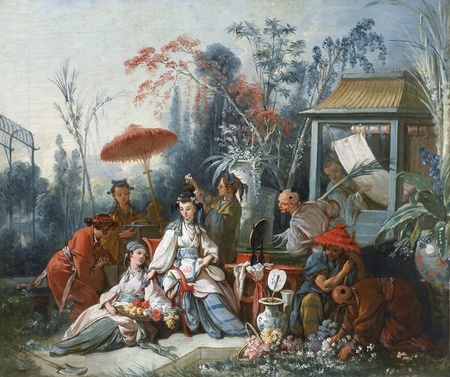
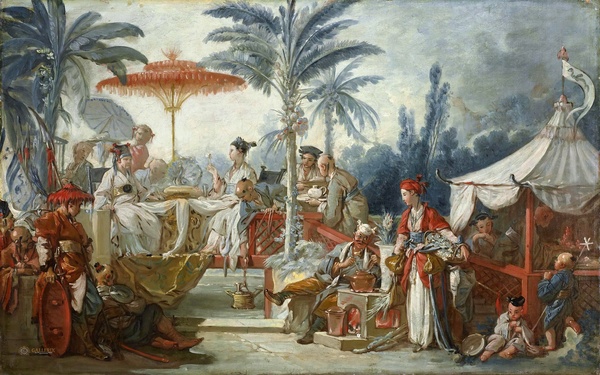
18th-century «China» in Europe was a beautiful fairy tale that aristocrats told one another. One of the main storytellers was François Boucher, the first painter to King Louis XV. In 1742, he created a series of canvases for the Beauvais tapestry manufactory that shaped the visual language of the era.

François Boucher, «The Chinese Garden» / «The Chinese Emperor’s Court,» 1742

In «The Chinese Garden,» we see an ideal, almost toy-like country, invented for the delight of the eye. The Chinese figures here are extras in whimsical costumes, resembling porcelain figurines come to life. The trees are too elegant, the pagodas unnaturally curved — it is all a mirage, behind which the real China is invisible, but the Rococo aesthetic is clearly seen. Even the porcelain vase in the foreground is not an everyday object, but a sign of «Chineseness» that a European was meant to recognize and appreciate immediately.In the pendant painting «The Chinese Emperor’s Court,» the story is less important than the decorative rhythm. The viewer’s gaze slides over bright spots — orange, blue, red — against a background of silvery-bluish foliage. This is no longer so much an image of China as it is a pattern ready to be transformed into a tapestry or a screen. The painting features plants not typical of China (for example, palm trees). This adds exoticism to the scene and creates a decorative effect.

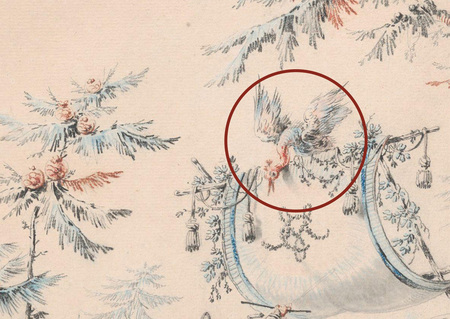
If Boucher’s paintings are a theater where the illusion of depth and volume reigns, his younger contemporary Jean-Baptiste Pillement (1728–1808) turned that theater into an ornamental pattern suitable for mass production.

[1] — example of Pillement’s fantastic birds; [2] — example of Pillement’s exotic plants

post

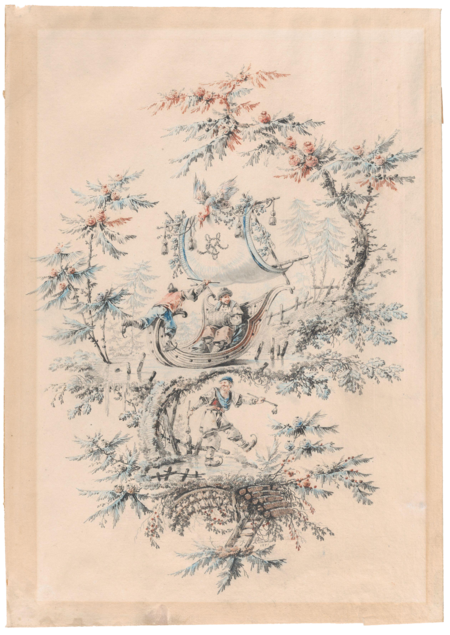
In his famous albums, such as «Cahier de Balançoires Chinoises,» he populates his compositions with incredible birds, dragons, and exotic beasts. The whimsical creatures, pagodas floating in the air, and idyllic scenes of his works are no longer just an applied pattern, but a kind of «Chinese utopia» transferred to paper.

Jean-Baptiste Pillement, «Cahier de Balançoires Chinoises,» 1770.

Original size 1540x1265

Jean-Baptiste Pillement, «Chinoiserie Ornament» series, one of the works, 1760-1785

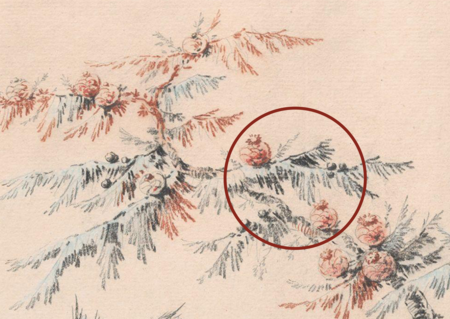
The etching «Chinoiserie Ornament» is a perfect example of how Pillement uses a new visual vocabulary. There are no complex characters like Boucher’s, but there are unusual, intertwined lines and patterns that do not depict anything specific yet create a sense of «Oriental» complexity and ornamentality. There are also elements of rocaille, which create an effect of lightness and airiness.

Pillement’s work clearly reflects the commercialization of «Chinese» motifs during the Enlightenment. Among the surviving objects of that era is an elegant fan painted after Pillement’s designs. Its mother-of-pearl base and delicate watercolor tones emphasize that the Chinoiserie aesthetic permeated not only painting and tapestries but also fashion and personal accessories.

Original size 3512x1964

French fan based on designs by Jean-Baptiste Pillement, 1760–1770

Looking at Pillement’s «Chinoiserie Ornament» etching again, one might wonder: these fantastic birds, swirls, flowers… what do they have in common with the real China? The answer is simple: they are a pure product of European fantasy. Moreover, Pillement himself was not a pioneer. He drew on the tradition of French grotesques, reimagined by Antoine Watteau, merely adapting it to Eastern themes. Thus, a chain of borrowings was established: Watteau — Pillement — all of Europe.

And now, this ornamental wave reaches London, where Thomas Chippendale is at work.

Original size 2784x1699

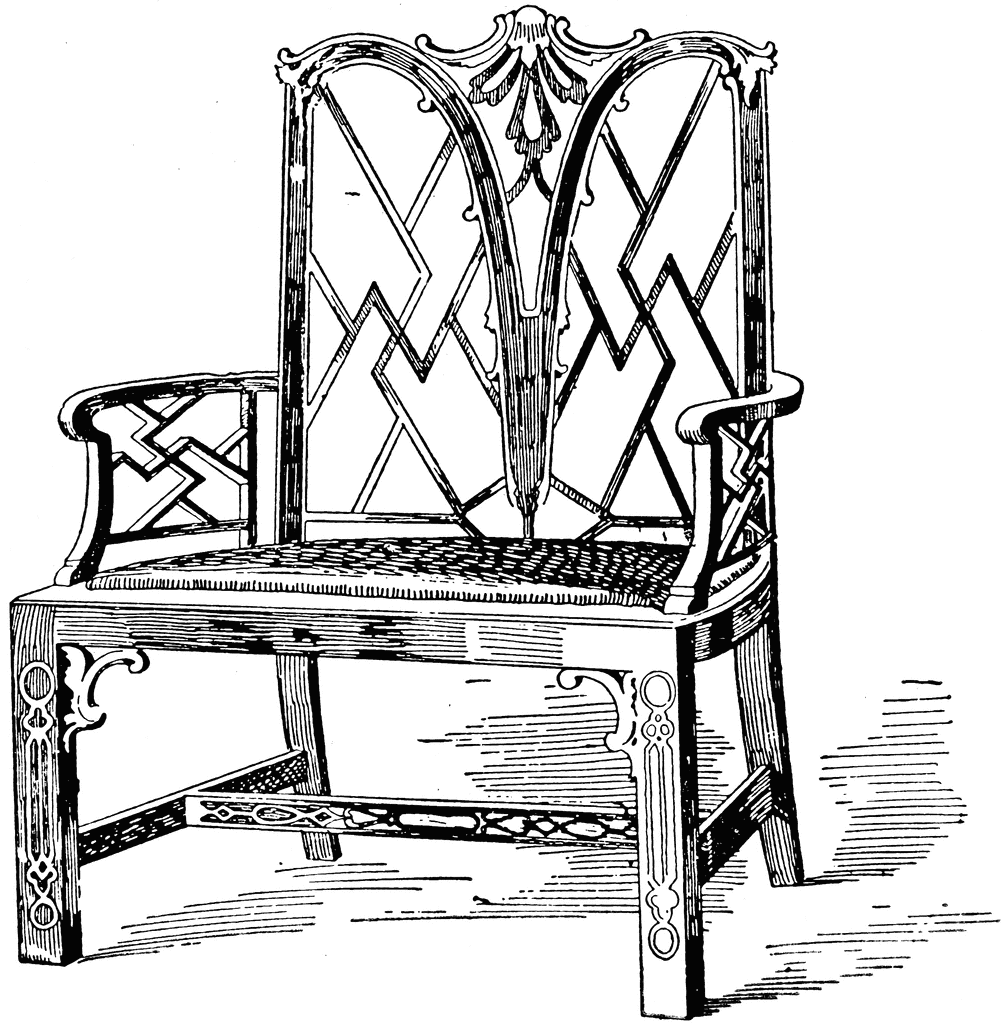
Thomas Chippendale, design for «Chinese chairs,» 1754

post

Comparing Chippendale’s sketches with Pillement’s etchings reveals an interesting distinction. Pillement emphasized illustrativeness, depicting animals and fantastic plants. Chippendale, however, brought a different kind of Eastern inspiration. Both masters had never been to China, but their interpretations of Chinese motifs differed greatly.Chippendale’s chairs, though called «Chinese,» did not copy actual Chinese furniture. Authentic Chinese pieces are massive, made of hardwoods, and minimally decorated. Chippendale’s chairs are a stereotypical embodiment of the English fantasy of the East. The English saw lightness, fretwork, and a certain exoticism in China, even though they actually knew very little about it.

Chippendale’s stereotypical visions of China represent one path. Another, opposite path was chosen by Sir William Chambers (1723–1796), an architect who actually traveled to China and even wrote a treatise on the architecture of the Celestial Empire.

Original size 3539x2394

Sir William Chambers, The Great Pagoda at the Royal Botanic Gardens, Kew, 1762, London, UK

His Great Pagoda in Kew Gardens (1762) is striking in its specificity—the structure truly resembles Chinese prototypes.

post

I want to attempt a comparison between a traditional Chinese pagoda and Chambers' Pagoda at Kew.

Number of floors: Odd (7 or 9) — Even (10) Decorations: Dragons only on corners — 80 gilded dragons around the entire perimeter Function: Religious building — Attraction in an English park Color: Natural tones — Bright, exoticized

It would seem that with such scrupulousness, Chambers should have created an exact copy. But no. He made a replica of the Nanjing Pagoda, which nevertheless remained a fantasy. Its ten floors instead of nine is a critical deviation from the Buddhist canon. This was not ignorance, but a conscious adaptation to European taste and architectural logic. Even when trying to be accurate, Europe could not resist the temptation to reinvent the East at its own discretion.

0

Meissen porcelain manufactory, pagoda-shaped teapot, 1735

post

The Meissen porcelain teapot in the shape of a pagoda shows how Europeans imagined China. The spout of the teapot resembles a tree trunk, which is found in neither Chinese nor European culture. This is simply a fiction by artists who drew China according to their own ideas. For them, China was a set of familiar symbols that they could use in their work.

Meissen masters took the form of a Chinese porcelain wine jug as a base but painted it in a European style. On one side of the teapot, people in unusual outfits are drawn against a background of a palm tree. On the other side, three people in the same outfits are shown preparing tea.

Thus, Europeans were fascinated by China but often depicted it differently from how it actually was. In Meissen porcelain of the 1720s, these images are executed beautifully, with humor and in a playful style, making them some of the best examples of the Chinoiserie genre.

But the most interesting thing happens when the other side — China — enters this dialogue.

This work is a perfect example of the occidenterie movement. It is China’s «mirror response» to European Chinoiserie. The Chinese master does not simply record reality; he constructs an image of the West (represented by European merchants and their world) for the Western viewer, demonstrating how he sees and how he wishes to be seen.

Original size 4000x2667

Unknown Chinese Artist, «Whampoa Anchorage on the Pearl River,» c. 1800

Unknown Chinese Artist, «Whampoa Anchorage on the Pearl River,» c. 1800

The artist employs Western perspective and oil painting to create a document understandable to a European. This is a conscious step toward dialogue. However, a fundamental visual gap emerges: while Western architecture and ships gain volume and realism, the human figures remain small, flat, and almost «pasted» into the landscape. This is neither an accident nor an error. It is a manifestation of a deep cultural code. Unlike the Western tradition, where the individual is often the center of the composition and the primary actor, in classical Chinese landscape painting (shan shui), human figures—if present—are usually small and dissolved into the grandeur of nature. This creates a sense of human humility before the power of the universe and emphasizes the role of the person as an observer rather than a conqueror of space.

0

Xu Yang, «Prosperous Suzhou,» 1759

In the 18th and 19th centuries, European art influenced Chinese art, as seen in the example of the Suzhou scroll. This scroll combines Western linear perspective with traditional Chinese techniques, demonstrating the adaptation of European elements while preserving Chinese culture. The subject matter of the scroll is a realistic depiction of life in Suzhou, rather than Chinoiserie stereotypes. Chinese artists used European techniques to create harmonious compositions, maintaining their identity and producing a historical document of an 18th-century Chinese city.

Thus, 18th–19th century European Chinoiserie and its Chinese counterpart, occidenterie («the Western wind»), are characterized by several key features. These traits are now easily recognizable thanks to widespread visual stereotypes.

post

On one hand, European artists construct an ideal, decorative China, where charm, ornamentality, and the play of form are more important than accuracy. On the other hand, Chinese masters of export art and occidenterie strive to imitate Western perspective and realism but inevitably distort them, creating an equally fantastical image of Europe.

The unifying factor is the dissonance between the actual culture and its artistic representation: both Europe and China saw each other not as they truly were, but as they wished or were able to see them. Chinoiserie is not a dialogue, but a parallel production of dreams.

In the 19th century, Chinoiserie briefly disappears due to the political climate on both sides. Despite this, in the 1920s, the Chinese style regains popularity once again.

Chapter 2. The Turning Point

By the beginning of the 20th century, European Chinoiserie, which had turned into a mass-produced pattern, gradually exhausted its relevance as a unified style. However, the interest in the «Oriental» did not disappear—it transformed. Instead of a holistic decorative system, separate, autonomous gestures emerged: aesthetic admiration, «Oriental-style» stylization, and the cynical appropriation of the language of mass culture. Meanwhile, Chinese artists, finding themselves in Europe, began to master Western techniques to find their own path in the modernization of national art.

This work clearly demonstrates how, during the Art Deco era, the East became not just a theme, but a synonym for luxury, sophistication, and refined sensuality.

post

Erté uses a minimalist palette (scarlet, black, gold) and elongated, graphic silhouettes to create the image of a distant princess. In this work, the Oriental motif becomes pure glamour—the exotic is finally detached from reality and turned into a fashion trend.

Erté, «Princess of Asia», private collection

Erté, «Bamboo» / «Characters», 1924

post

[«Bamboo»] — here Erté consciously avoids the blue, red, and green—colors that dominated 18th-century Chinoiserie, such as in Boucher’s work or Meissen porcelain. Bamboo is not depicted as a plant. It is transformed into an architectural lattice on the body. The flexible, natural stem has become a rigid geometric construction.

[«Characters»] — here the title itself refers to abstract concepts rather than China. Erté completely detaches the form from its ethnographic source. This «Orientalness» is read only through a sense of ceremonialism, layering, and a certain preciousness.

While Western artists borrowed, 20th-century Chinese painters also learned from Europe. Xu Beihong and Lin Fengmian studied in France at the same time. Both sought to modernize Chinese art but chose different paths.

Original size 2678x1334

Xu Beihong, «Six Galloping Horses,» 1942

Xu Beihong relied on realistic academicism, harmoniously integrating Western techniques into traditional Chinese Gongbi. His central subject is horses. In the painting «Six Galloping Horses» executed in ink on paper (referencing the classical Chinese school of painting), the artist conveys anatomy and movement with almost photographic precision—a skill that cannot be acquired without studying European drawing. The drawing shows complex and intersecting perspective points, which is also linked to the author’s Western European education. However, Xu’s protagonist is not «China for Europe» but China for itself—reforming and seeking its own path.

Lin Fengmian’s paintings are a brilliant example of synthesis, where Eastern contemplativeness meets Western modernism. As one of the «fathers» of modern Chinese painting, he did not simply copy Western techniques but used them to «rejuvenate» Chinese tradition.

Lin Fengmian, «Lady Christie» / «Woman with a Lily in Her Hands», no date

post

[«Lady Christie» and «Woman with a Lily in Her Hands»] represent a harmonious fusion of Eastern calligraphy and Western modernism. In both works, the master uses the traditional «iron wire» line (tiexian miao) to outline the classical image of a beauty (meiren). However, in his work, this line is subordinated to European geometry: the figures are inscribed into an atypical square canvas and simplified into laconic ovals in the spirit of Matisse and Modigliani. The artist’s main innovation lies in his treatment of light and space. Instead of the traditional void of the background, he uses an Impressionist play of spots: whether in the soft drapery of the interior or the dynamic greenery in «Woman with a Lily». By applying the Western technique of layering white paint and gouache, Lin Fengmian achieves a «glowing» effect on the translucent robes and petals. Thus, Western tools — light, volume, and square composition — do not displace the Chinese soul but transform quiet Eastern melancholy into the universal language of modern art.

Zao Wou-Ki is a master who combined Chinese calligraphy with Western Abstract Expressionism, becoming part of the «School of Paris».

Original size 1546x2000

Zao Wou-Ki, «29.01.64», 1964

post

In the painting «29.01.64», Zao Wou-Ki radicalizes Lin Fengmian’s ideas, abandoning the figure in favor of pure energy. He uses Western canvas and oil techniques to depict the elements, combining the scale of Abstract Expressionism with Chinese elements. Thick brushstrokes and dramatic colors resemble Hans Hartung, but the center of the composition is permeated with thin calligraphic lines reminiscent of ancient Chinese inscriptions. Zao Wou-Ki transforms light into a mystical void, conveying the «spirit resonance» through the chaos and order of the strokes, freeing Chinese painting from objectivity. Many researchers see in these structures the outlines of the character 山 (shān — mountain) or 水 (shuǐ — water), but in a highly distorted, «exploded» form. This is a conscious move away from literariness toward pure visual poetry.

From the expressive «inner explosion» of Zao Wou-Ki, his contemporary Wu Guanzhong moves toward ultimate external tranquility.

Original size 2712x1352

Wu Guanzhong, «Two Swallows», 1981

post

The composition is built on the principles of Western formalism. The vast white wall, which occupies most of the canvas, is a pure geometric plane. The strict rhythm of horizontal and vertical lines reveals the influence of European modernism and the abstractions of Piet Mondrian. Although the painting is made in a Western style, it is very poetic and reminiscent of traditional Chinese painting. The monochrome palette evokes Chinese ink wash painting and the architecture of the Jiangnan region.

The white wall here is not just an empty space, but a symbol of emptiness and tranquility in Chinese culture. Two small swallows in the sky bring the picture to life, transforming it from a simple draft into a living moment.

In the 20th century, the paths of East and West finally diverged, even though artists continued to look at one another.

For Western Art Deco and Erté, China became a beautiful fairy tale — a set of fashionable clichés, gold, and glamour. At the same time, Chinese masters themselves used Western modernism as «fresh blood» to pull their tradition out of stagnation. The main point here is the struggle against inertia. While the West was turning the East into expensive packaging, Chinese artists took up European brushes to restore life and sincerity to art.

This was a moment of truth: the East ceased to be just a pretty picture in the eyes of a European and began to dictate the rules itself, rewriting the global code of art.

Chapter 3. «The Other’s Response»

Wang Xingwei builds a fundamentally different model of synthesis: if his predecessors sought aesthetic harmony, he uses the Western canon as a tool for conceptual irony and the deconstruction of stereotypes.

post

On one hand, the artist demonstrates a flawless mastery of the Western «Old Masters» technique — from Dutch-style chiaroscuro to surrealist grotesque and the deformation of faces resembling masks. On the other hand, he places deliberately mundane, almost kitsch attributes of Chinese everyday life into this «high» pictorial context: a sewing machine, a pot of chrysanthemums, and the aesthetics of commercial folk art (lubok).

Unlike Lin Fengmian, Wang Xingwei intentionally rejects «Oriental elegance» and calligraphic quality, proving that a contemporary Chinese artist can freely dispose of world heritage, turning Western oil painting into an ironic language for analyzing their own reality.

Wang Xingwei, Untitled («Old Lady No. 2»), 2011

If Wang Xingwei ironizes the very style of painting and how absurd the «Chinese» looks in a «European» suit, then Xu Zhen goes further. He shifts irony from the plane of the canvas to the plane of the global art market.

In the work «Bodhisattva from Tianlongshan Caves, Winged Victory of Samothrace», Xu Zhen performs a mirror gesture toward classical Chinoiserie: the key image here is the Winged Victory of Samothrace turned upside down — stripped of her triumphant flight, the pride of the Louvre is reduced to the function of a technical support, which finally shatters the old cultural hierarchy.

Original size 3500x3500

Xu Zhen, «Eternity — Bodhisattva from Tianlongshan Caves, Winged Victory of Samothrace», 2013

post

If in the 18th century Europeans constructed a myth about the East, now a Chinese artist appropriates the main symbol of Western triumph, turning it into a physical support for an Eastern deity.

Unlike 20th-century modernists who sought the harmony of synthesis, Xu Zhen captures the absurdity of globalization, where the sacred symbols of both civilizations become parts of a flashy construction set.

Thus, in the 21st century, Chinoiserie transforms from a decorative style into a tool of visual power, asserting the East’s right to reassemble world history according to its own rules.

While Xu Zhen plays with global symbols of power, Fung works with «intimate» Chinoiserie — those very elegant trifles (fans, cages, porcelain) that have decorated European living rooms for centuries.

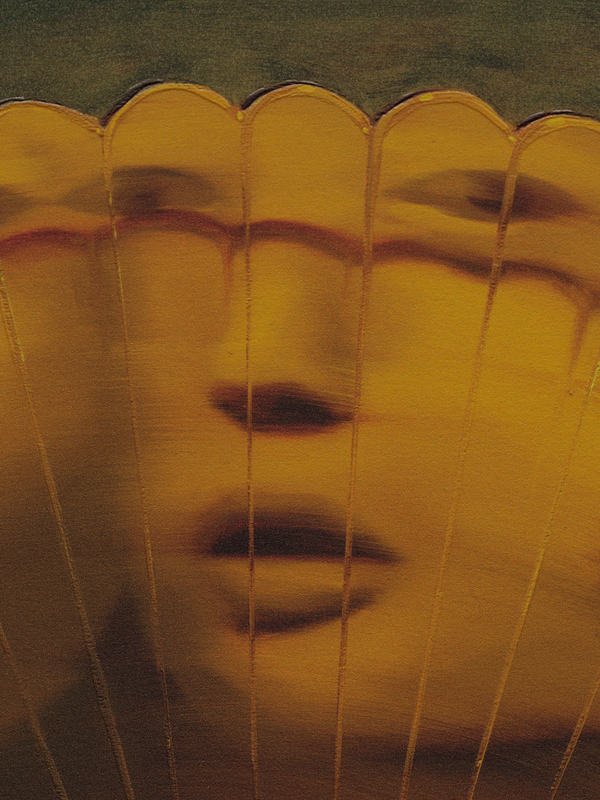
Dominique Fung, «Bone-Holding Fan», 2021

Fung deconstructs the image of the Eastern woman as a «beautiful vase» or a «fragile fan». She shows that objectification was hidden behind the elegant gilding of the 18th century. While in the first chapter the fan was a symbol of coquetry, in Fung’s work it becomes a symbol of «museum death» and colonial captivity.

The process of deconstructing the myth is completed by Yuxing Chen. While previous artists reimagined Chinoiserie through irony or physicality, Chen, in her project «Oriental Scene» (2026), chooses a radical gesture — she completely removes the object from the field of vision.

Original size 2000x2500

Yuxing Chen, «Oriental Scene» — The Great Pagoda in Kew Gardens, 2021-2026

post

In the main photograph, the artist literally «erases» William Chambers' pagoda, turning it into a white spot. This is an act of decolonial surgery. Chen shows that the building, which for 260 years was considered «Chinese», is actually a void in a historical sense. If Chambers in the 18th century added extra floors (10 instead of 9) and golden dragons to create an «exotic attraction», then Chen in the 21st century erases the architecture itself, exposing the falsity of this construct.

The white silhouette is a metaphor for cultural amnesia: behind this facade, there was never a genuine China, only a Western fantasy.

0

Yuxing Chen, «Oriental Scene» — Small Pagodas and Bridges, 2021-2026

The rest of the photographs in the series extend this «archaeology of errors» to the entire landscape of the European garden.

The pagodas in scaffolding emphasize that Chinoiserie is an «eternally under construction» and editable myth. For Chen, restoration is not a return to truth, but merely a refurbishing of an old lie.

By painting over gazebos and bridges, the artist turns them into ghosts. She demonstrates how Orientalist clichés «clutter» real space, becoming blind spots that the viewer has grown accustomed to not noticing.

Conclusion

Concluding the research, it can be stated with confidence that over three centuries, the image of China has traveled the path from a decorative «screen» to a tool of rigorous intellectual reflection. We have seen how European Chinoiserie transformed from an innocent fantasy into an object of decolonial investigation.

The main result of the work lies in the change of roles. If in the 18th century François Boucher or William Chambers created a «convenient» East, turning pagodas and fans into park attractions, Chinese artists of the 20th and 21st centuries have completely seized the initiative. Where the masters of the past were engaged in exoticization, Xu Beihong and Lin Fengmian began a search for a living synthesis, using Western modernism as a way to restore relevance and a voice to Chinese art.

It is interesting that contemporary authors, such as Wang Xingwei and Xu Zhen, have chosen the path of «reverse appropriation». They no longer try to fit into the Western canon; on the contrary, they use it as a construction set. This allows them to ironically juxtapose the Winged Victory of Samothrace with the Bodhisattva, exposing the absurdity of old stereotypes. In this context, Yuxing Chen’s work with the «white pagoda» at Kew becomes the logical finale of the entire story: to get rid of Orientalist layers, the artist chooses a radical «erasure» of the image itself.

Thus, the hypothesis put forward has been confirmed: Chinoiserie has indeed evolved from naive exoticism to conscious deconstruction. Contemporary Chinese artists today are not just creators but critics who, through irony and archival work, transform the old European fantasy into a space for a new, honest dialogue between cultures.

The Orient is not only adjacent to Europe; it is also the place of Europe’s greatest and richest and most recurring images of the Other.

Bibliography
1.

Abramova, N. A. Traditsionnaya kultura Kitaya i mezhkulturnoe vzaimodeystvie (sotsialno-filosofskiy aspekt) [Traditional Chinese Culture and Intercultural Interaction (Social and Philosophical Aspect)]. Chita: ChitGTU, 1998. — 303 p.

2.

Bazhanov, E. P. Kitay i vneshniy mir [China and the Outside World]. Moscow: Mezhdunarodnye otnosheniya, 1990. — 351 p.

3.

Vinogradova, N. A., Kaptereva, T. P., Starodub, T. Kh. Traditsionnoe iskusstvo Vostoka: terminologicheskiy slovar [Traditional Art of the East: A Terminological Dictionary]. Moscow: Ellis Lak, 1997. — 360 p.

4.

Glovacheva, L. I. «Dukhovnyy poisk Lin Fenmyanya: mezhdu Vostokom i Zapadom» [Lin Fengmian’s Spiritual Quest: Between East and West]. Iskusstvo Vostoka [Art of the East], no. 4 (2011): 112–119.

5.

Glukhareva, O. N. Izobrazitelnoe iskusstvo Kitaya [Visual Arts of China]. Moscow: Gosudarstvennoe izdatelstvo izobrazitelnogo iskusstva, 1956. — 148 p.

6.

Neglinskaya, M. A. Shinuary v kitayskom eksportnom iskusstve XVIII–XIX vekov [Chinoiserie in Chinese Export Art of the 18th–19th Centuries]. Moscow: GII, 2015. — 468 p.

7.

Said, Edward W. Orientalism. Western Conceptions of the Orient. (Original publication: 1978). St. Petersburg: Russkiy Mir, 2006. — 637 p.

A Dream of the Celestial Empire: Chinoiserie from Boucher to Yuxing Chen
Project created at 05.05.2026
We use cookies to improve the operation of the website and to enhance its usability. More detailed information on the use of cookies can be fo...
Show more