Brand Overview and History
Within the framework of this project, we examine the Red Bull brand — one of the most recognizable and successful brands in the global energy drink market.

Red Bull Racing RB19
Red Bull GmbH was founded in Austria. In 1982, Dietrich Mateschitz became interested in energy drinks. At that time, such beverages were popular in East Asia but did not exist in Europe. Dietrich Mateschitz acquired the rights to the Thai brand «Krating Daeng» (which translates as «Red Bull») and the use of a formula from Taisho Pharmaceuticals (Japan). In 1987, Red Bull began being sold in Austria as a product designed to improve concentration. In the 1990s, the product appeared on the shelves of neighboring European countries. However, the real boom in popularity — when energy drinks became a массовый trend among young people — occurred in the 2000s. Today, Red Bull holds around 43% of the global energy drink market, remaining the absolute industry leader. The company sells nearly 14 billion cans per year, generating net revenue exceeding €12.2 billion.
Marketing Strategy, Positioning, and Target Audience
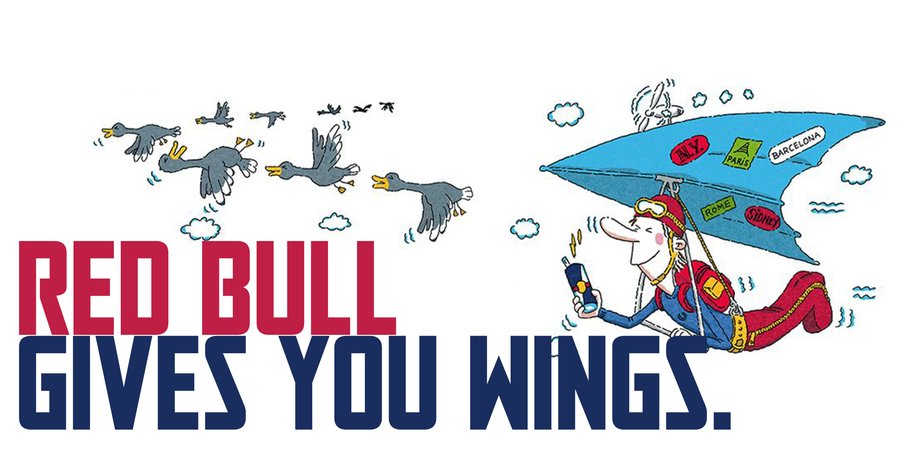
Since its launch, the brand has become a leader in innovative marketing and communication. Red Bull builds its strategy around creating a unique experience for its audience. The brand’s key slogan — «Red Bull gives you wings» — reflects the core idea of going beyond ordinary limits. The brand appeals not so much to the functional characteristics of the product as to its emotional and symbolic meaning.
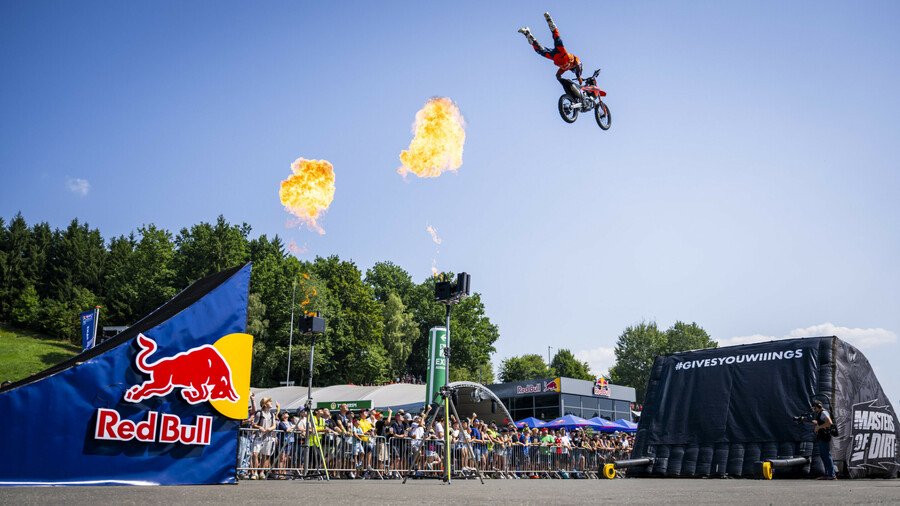
Red Bull Hardline 2022
Red Bull MotoGP
Red Bull advertisement and slogan
Red Bull’s positioning can be defined as a lifestyle brand associated with energy, activity, and extreme sports. The company acts as a media platform, creating content, events, and cultural phenomena. This allows the brand to build a strong connection with values such as freedom, risk-taking, achievement, and self-expression. In terms of gender, the audience is predominantly male, but the brand also actively attracts female consumers through lifestyle and dance-related events.
Red Bull’s target audience mainly consists of young people aged 15 to 35 who lead active lifestyles and seek new experiences. These include students, athletes, creative professionals, and achievement-oriented individuals. A key characteristic of this audience is a drive for self-realization, an interest in extreme activities, and a desire to be part of a dynamic and inspiring environment.
Articles on the Red Bull website
Communication channels
Red Bull currently positions itself not as a manufacturer of invigorating drinks, but as an event organizer. Earlier, the company’s slogan was mentioned: «Red Bull gives you wings», which is translated not through the product, but through events, inspiration for action for implementation. This shows the general strategy of the brand: «We don’t sell a drink — we sell a lifestyle». Thus, the company responds to the internal desires of the target audience, depending on the category of the viewer/consumer, the company embeds communication channels in different ways, responding to the needs of a specific category of consumer.
Social media
Social media of Red Bull
One of the communication channels is social networks, where the main group of the younger generation (Millennials and Gen Z), appreciating aesthetics and life, as well as emotions and bright accents, which clings to the fake thinking of this generation. The content focuses more on short dynamic videos, high-quality photos, and an emphasis on the emotions of the moment.
Social media of Red Bull
It is impossible not to mention «naturalness and immediacy» in social networks, in short videos you can observe: raw, unedited content, backstages, POV (first-person view), participation in trends. It attracts, evokes emotions, which is what Red Bull carries in its slogan.
Website of Red Bull
Website
I want to pay special attention to my own channels. This is the foundation of Red Bull communication. The brand controls the agenda itself and creates its own ecosystem of communications, where everyone can choose entertainment for themselves (starting from extreme sports. Ending with creativity, music), because the company’s audience is not only extreme sports athletes, but also creative people. For example, for more global fans of extreme sports, the company has created its own TV (Red Bull TV). In this format, the focus is on documentaries or the broadcast itself from extreme sports events.
Articles on the Red Bull website
TV, magazine, podcast, broadcasts
Earlier, the creative target audience was also mentioned, which is close to underground music, rock, music that evokes emotions, in this communication channel interviews musicians are also taken or music sets themselves are created for the company (Red Bull Radio). From this series, a podcast about sports and news was created, which is in demand among the middle-aged generation. For lovers of aesthetics, millennials are more of this category, the company began to publish a glossy magazine with texture photos and interviews with athletes (The Red Bulletin). All the above-mentioned categories can be found on the company’s unified media platform, where you can also learn about upcoming events from Red Bull (Redbull.com). From this you can see that the company sells not energy, but the content itself, emotions that the viewer chooses for his interests, which is a strategy (content as a product).
Sponsorship
The next strategy is cultural sponsorship. Red Bull is deeply embedded in subcultures, thus again responding to the desires of its target audience. For example, one of the bright segments of the company’s audience are students, so Red Bull can be seen in student events (Sponsorship of eSports tournaments, Red Bull Amaphono — art, public installations, street art projects, festivals, collaborations with artists).
Events of Red Bull
Own events
It should also be said that the company not only sponsors, but also creates sports and extreme events itself. This is a unique strategy that turns a brand into a producer
Red Bull Stratos (2012) is a jump from the stratosphere. 8 million people watched it live. Became one of the most viral events in the history of PR.
Red Bull Rampage is a freeride Mountain Bike Championship in the Utah Desert.
Red Bull BC One is the main world breakdance tournament.
Red Bull Flugtag is a festival of homemade aircraft.
Red Bull Crashed Ice — ice skating race.
Red Bull Romaniacs is a hard enduro in Romania.
Ambassadors
Also, in support of its events, Red Bull creates its own team of heroes. The company does not just sponsor athletes — it hires them as ambassadors for a long time. This creates the narrative of the «Red Bull family».
Red Bull family

Poster of Red Bull
THEORETICAL FRAMEWORK
Uses and Gratifications Theory
Uses and Gratifications Theory (UGT) is a media communication theory developed by Elihu Katz, Jay Blumler, and Michael Gurevitch. Unlike traditional media theories that focus on what media do to audiences, UGT examines what audiences do with media and why they choose specific content.
According to the theory, people actively select media that satisfy their personal needs and motivations. Audiences are not passive recipients of information but active participants who seek content that provides value and meaning.
The main gratifications identified by the theory include:
— Entertainment and enjoyment — Escapism and emotional release — Social interaction and belonging — Information and learning — Personal identity and self-expression
This theory is particularly relevant for analyzing Red Bull because the brand does not rely solely on product advertising. Instead, it creates media experiences, events, and content ecosystems that satisfy multiple audience needs simultaneously.
Content Marketing
Content Marketing refers to the strategic creation and distribution of valuable, relevant, and engaging content to attract and retain a clearly defined audience.
Rather than directly promoting products, content marketing focuses on building long-term relationships through entertainment, education, and storytelling.
Red Bull is often considered one of the world’s most successful examples of content marketing. The company produces documentaries, sports broadcasts, magazines, podcasts, social media content, and live events that audiences consume independently from the product itself.
The combination of Uses and Gratifications Theory and Content Marketing provides an effective framework for understanding why Red Bull’s communication strategy has become so successful.
ANALYSIS
Extreme Sports as Entertainment and Escapism
One of Red Bull’s most recognizable communication strategies is its focus on extreme sports. Activities such as skydiving, mountain biking, freestyle motocross, surfing, and Formula 1 create highly engaging content that captures audience attention.
From the perspective of Uses and Gratifications Theory, extreme sports satisfy the audience’s need for entertainment and escapism. Viewers experience excitement, adrenaline, and emotional stimulation without personally participating in dangerous activities.
The content allows audiences to temporarily escape everyday routines and experience extraordinary situations through athletes and performers. As a result, Red Bull becomes associated with freedom, adventure, and achievement rather than with an energy drink.
Events as Social Interaction
Red Bull’s events serve a function beyond simple entertainment. Competitions such as Red Bull BC One, Red Bull Rampage, Flugtag, and Crashed Ice create communities around shared interests and values.
According to UGT, media users often seek opportunities for social interaction and belonging. Red Bull events encourage participation both offline and online through live attendance, social media discussions, comments, and content sharing.
These activities strengthen audience engagement and help create a sense of membership within the broader Red Bull community. The brand becomes a cultural platform where people connect through common passions.
Video Content and Storytelling
Video is one of Red Bull’s most powerful communication tools. The company produces documentaries, athlete profiles, behind-the-scenes footage, event highlights, and cinematic short films.
Storytelling is particularly effective because audiences connect more strongly with narratives than with traditional advertisements. Instead of focusing on product features, Red Bull tells stories about overcoming challenges, pursuing ambitions, and achieving extraordinary goals.
The Red Bull Stratos project provides a clear example. The event was not presented as a product promotion but as a human achievement story involving courage, innovation, and exploration. As a result, audiences engaged emotionally with the content and transferred these positive associations to the brand.
Content as a Product
A unique aspect of Red Bull’s communication strategy is that content itself becomes the product. Consumers do not engage with Red Bull solely because they purchase a beverage; they engage because they enjoy the media ecosystem created by the company.
Through Red Bull TV, Red Bull Radio, The Red Bulletin, social media platforms, and live events, the company continuously provides entertainment, information, and inspiration.
This strategy creates long-term relationships with audiences and reduces dependence on traditional advertising methods.
Building Brand Identity Through Heroes
Red Bull also strengthens its communication through long-term partnerships with athletes, musicians, and creators. These individuals function as brand ambassadors and represent the values associated with Red Bull.
Instead of using traditional celebrity endorsements, the company develops authentic narratives around real achievements and personal journeys.
This approach creates credibility and allows audiences to identify with the individuals who embody the brand’s lifestyle and philosophy.
CONCLUSION & RECOMMENDATIONS
The analysis demonstrates that Red Bull has successfully transformed itself from an energy drink manufacturer into a global media and lifestyle brand.
Using content marketing, storytelling, event production, and community-building strategies, the company satisfies multiple audience needs identified by Uses and Gratifications Theory, including entertainment, escapism, social interaction, and self-expression.
As a result, Red Bull has created one of the strongest emotional connections between a brand and its audience in contemporary marketing.
Strengths
— Strong and consistent brand identity. — High-quality content production. — Successful integration into sports, music, and youth culture. — Creation of a self-sustaining media ecosystem. — Strong audience engagement and loyalty.
Weaknesses
— Heavy dependence on extreme sports positioning. — Limited appeal to older demographic groups. — High costs associated with content production and event organization. — Potential oversaturation of branded content.
Recommendations
— Expand communication toward sustainability and environmental initiatives. — Increase content focused on creativity, innovation, and technology. — Strengthen engagement with female audiences. — Develop more interactive digital experiences using emerging technologies. — Continue diversifying content categories while maintaining the core brand identity of energy, inspiration, and achievement.
Red Bull official website (https://www.redbull.com)
Red Bull Media House (https://www.redbullmediahouse.com)
Red Bull TV (https://www.redbull.tv/ru_RU)
Championship of Red Bull (https://www.championat.com/tags/469-red-bull/)