CONTENTS
CONCEPT
SHADES OF SURREALISM IN INSTITUTIONAL CRITICISM
SURREALISTS' EXHIBITIONS AND THEIR LANGUAGE INSTITUTIONAL CRITICISM A Case Study of «Exposition Internationale du Surréalisme» Paris 1938
SCENOGRAPHY AND SET DESIGN OF THE EXHIBITION The multi-sensory dreamscape
Performances.
MANNEQUINS (Le Mannequin des surréalistes) The surrealist description of man with a human replica.
Re-thinking already mades as surreal Installations and video Avant-garde art.
The Twine Installation, First papers of surrealism 1942. Installation by Duchamp
Rejiggering Films into surreal, cinema.
REFERENCES
IMAGE SOURCES
CONCEPT
As a movement by the poets, surrealism blossomed like a move towards allowing the power of imagination and subconscious creativity to express themselves in a discipline beyond the human imagination. Andre Breton, a poet and critic, fostered the notion through his «manifesto of surrealism» in Paris in 1924. Surrealism movement and style had been formed as a move against the pre-existence of the retinal art «Art that is appealing to the eyes (according to Marcel Duchamp)» to the art of mind and intellectual imagination through creating imagery and stories with dreamlike compositions and images. The poets of surreal art were at first not interested in engaging visual artists because of the rigidity that existed in the creation of visual art, which had been accorded by many institutions of the time as a norm of only painting, drawing, and sculpting. However, Breton and his disciples later engaged visual artists like Giorgio de Chirico, Marcel Duchamp, and Pablo Picasso whose works had proved to align perfectly with surrealism. In this study, we observed surrealism exhibitions as an institutional criticism since the style had clear motives of funning away from the normal way of creation to a more free way of creating work. As mined mine deep into the first surrealist exhibitions that were organised just after the movement was introduced in 1920 and among them we considered only Exposition Internationale du Surréalisme was an exhibition by the surrealists in Paris, January 17 to February 24, 1938 at Galérie Beaux-Arts and The First Papers of Surrealism exhibition, which opened on October 14, 1942 at the Whitelaw Reid Mansion in midtown ManhattanSurrealism. Surrealism directly attacked rationalism and order in creation and public expositions of work as the claim still stood that these were reinforcing fascist and capitalist social structures in which the museums were actively promoting. Surrealists had a direct aim to target the Bourgeois whose main aim in the creative industry was to accumulate wealth by leaning against the public institutions. Surrealists abandoned the aesthetic demands and the common rational principles and only paid attention to the psychic part of within the art.
Andre Breton, source [Artsy]
The movement blossomed in the 1910s-1920s as a revolution in literature by introducing automatic writing. This was to enable the work of literature specifically the poems and prose to be more diverse and experimental in an intellectual way, to explode the power of imagination beyond the formal way. This was the exploration of dreamlike imagery and re-creation of an imaginary universe.
The surrealism movement was inaugurated by Andre Breton in 1924. After his constant criticism of the rational art claiming it to be just «retinal». Breton a French Poet who was exploring in the Dada period was the pioneer of the movement. Breton describes the style as «Psychic automatism in its pure state» according to his definition; SURREALISM, n. «Psychic automatism in its pure state by which one proposes to express — verbally, by means of the written word, or in any other manner, the actual functioning of thought. Dictated by thought, in the absence of any control exercised by reason, exempt from any aesthetic or moral concern» (Source: www.khanacademy.org) And according to his definition, Breton portrays surrealism as a free thought without any restrictions on the principles of art that guide aesthetic expressions and any ethical standards, but just expressing the art in its raw state, which he refers to as “ psychic automatism in its pure state» This clearly links us back to the style of Dadaism, which cared less about the aesthetics and the moral principles but just an expression of thought and protest in any way possible. Perhaps, Dadaism still stands as a precursor of surrealism. However, Dadaism by 1924 lost its purpose following the end of World War 1 in which the style was popularised as a protest and propaganda against the war. This style later dissolved into surrealism, which had a more universal purpose and a more intellectual approach in both literature and visual art. Surrealism from its own perspective directly adapted to present themes and concepts of institutional criticism starting from the rational principles to attacking the Bourgeois (nobles) culture and values which were at a peak in these institutions. Creating without bearing any authoritative restrictions and aesthetic goals, surrealists only paid attention to the expression of the primary message in the artwork, as it was stated in encouraged in Breton’s manifesto of surrealism.
Manifesto Of Surrealism
.
Andre Breton, 1924
«Manifeste du surréalisme, Éditions du Sagittaire, Andre Breton October 15, 1924 »
It was like a clear guidebook to the surrealism artists and those inspired by the movement. On October 15, 1924, Breton published the manifesto just two weeks after Yvan Goll had published his on October 1, the same year. In his publication, Breton describes Surrealism as: «Psychic automatism in its pure state, by which one proposes to express verbally by means of a written word or in any other manner, the actual functioning of thought. Dictated thought, in the absence of any control exercised by reason, is exempt from any aesthetic or moral concern.» The definition expresses a freedom of creation and expression, without restrictions or principles followed but just following the idea and thought the way it is in its original or raw state. Paying attention to the way the surrealists create their artworks, there is a clear distinction of them not being chained to the principles of art but rather expressing their ideas in any way possible. Rational art as opposed to surrealism keeps artists within boundaries of art principles with dos and don’ts, which influences the creation of highly summarised works of art, unlike surrealism, which neither follows moral concerns nor aesthetic values. In his Manifesto, Breton launches a a direct attack on the concept of «Rational arts “ as demanded and highly supported by the institutions, besides leaving no moral concerns for the Bourgeois (nobles), by giving freedom to the surrealists to wage attacks on them and condemn anything that seemed unsatisfying in their move towards institutional criticism.
So the question still stands on how the surrealism exhibitions were used as as direct tools towards institutional criticism and this is the pivot of our study, in which we have gone back in the days of theses exhibitions to investigate how they propagated institutional criticism within the spheres of creation of art, display, and innovations within a by then new innovation of surrealism.
SHADES OF SURREALISM IN INSTITUTIONAL CRITICISM
Surrealism exercised several forms Institutional opposition and criticism through undermining the institutional norms of operation in the line of rational order, aesthetics and politics. They exhibited a series of creations and exhibition arrangements that questioned the authority of the bourgeois culture and rationalism. The artists in this Avant-garde genre were fond of re-thinking the curation of art exhibitions of this period by changing the display and actual arrangement and organisation of their expositions.The surrealists went beyond paint on canvas to exploring installations created by re-assembling the original objects giving it an original look for example the installations at «The International surrealism exhibition in Paris in 1938 which featured artists like Andre Breton the organiser, Man ray, Marcel Duchamp and Salvador Dali. Installations and paintings exhibited at the show were critically a move that broke away from the chains of classical art and the rationalism that was imbedded in the Institutions by that time. Besides, the movement lacked any moral observations and a story line in their work but just a work without leaning gainst the principles but just an imaginary composition with dreamlike illusions away from the agitated institutional expectations.
SURREALISTS' EXHIBITIONS AND THEIR LANGUAGE IN INSTITUTIONAL CRITICISM
A Case Study of «Exposition Internationale du Surréalisme» Paris 1938
Exposition Internationale du Surréalisme was an exhibition by the surrealists in Paris, January 17 to February 24, 1938 at Galérie Beaux-Arts. The exhibition was organised by the founder of surrealism, writer and artist Andre Breton and his partner Paul Eluard, who was a poet. The exhibition featured strong minds in surrealism and innovation. Marcel Duchamp, Salvador Dali, Max Ernst, Man Ray, and Wolf Gang Paleen. This was the first surrealist exhibition in Paris which featured a number of visual artists and performers from 14 countries where over 60 artists showcased an array of over 229 works with great masterpieces from the main artists stated previously. All the artists blessed the exhibition with their great innovations, which gave the exhibition a vibrant atmosphere but with vivid knowledge of who meant what and what was meant by that!
Paris-surrealisterna Tristan Tzara, Paul Éluard, André Breton, Hans Arp, Salvador Dalí, Yves Tanguy, Max Ernst, René Crevel och Man Ray, Paris 1933. Photo: Anna Riwkin Source[messynessy.com]
A delegation of the creative minded, young, and ambitious artists who were led by Andre Breton in the middle. Salvador Dali, Man Ray, Marcel Duchamp and other artists. These were the pioneers of the surrealism style, with the inventor of the style, Andre Breton. However, Marcel Duchamp still kept the claims that he was not part of any group because himself in many interviews claimed not to like and joining any groups. However, the exhibition still remained an unavoidable fact to him because of the similar styles of what he loved most. So he and his «creative works» were present at the exhibition.
SCENOGRAPHY AND SET DESIGN OF THE EXHIBITION
The multi-sensory dreamscape
L’exposition Internationale du Surrealisme, Exhibition set up, Image by Man Ray source www.andrebreton.fr
As said by Max Ernst that that surrealism is meant to be a combination of elements which appear alien together, but if the proximity is created, these can provoke the highest poetical lighting. Source: (messynessychic.com) The exhibition was clearly an antonym of the norm of rational thinking, taking away the viewer’s imagination from reality to re-imagine and live into a surreal world without any rules of creation but just expressing one’s mind unfiltered. Perhaps the study serves to describe the details and language of the exhibition towards institutional criticism.
The exhibition featured senior artists and organisers Marcel Duchamp as the curator. Man Ray was in charge of lighting and photography. Mercel Duchamp created the ceiling installation with sacks of coal. Salvador Dali and Max Ernst were in full charge of technical work supervision, and then Wolfgang Palen took on the task of the entrance. Re-defining the exposition styles and giving a different meaning to art, going against the white wall display techniques, the exhibitors placed works in innovative ways and the stories told in all the artworks were completely abstract in nature, not direct, but still meanings could be read by those who paid attention. The lights were dimmed, the ceiling was embedded with 1,200 coal sacks by Marcel Duchamp, and the floor was left dirty, and installations of female mannequins all over the corridors were designed in different styles. Besides, the music inspired by the German military marching songs and roasted coffee smells all over the place! The entrance was like a portal to a new world of dreams and imagination, which gave the viewers a new experience, attracting 3000 people to the Les Beaux Arts Gallery on 17 January 1938 on the opening night! The exhibition was like an initiation ceremony from the rigid society of rationalism to complete freedom of expression.
Ceiling imagined by Duchamp for the international Exhibition of surrealism at the galerie des Beaux-Arts in 1938. source: [www.andrebreton.fr] On the (Left) a random rational gallery setting.
Images of the floor by Wolfgang Paalen for the international Exhibition of surrealism at the galerie des Beaux-Arts in 1938. source: [www.andrebreton.fr] Left random Gallery Images.
The 1938 International surrealist exhibition shifted a lot of norms from the usual rational and formal display of works and the entire exhibition lay out. In the Image we visually see a formal exhibition space and on the right a lay out of the ceiling by Marcel Duchamp completely running away from what is considered normal and criticism is definitely traced at work. The Surrealists made the exhibition ground not just a store for works but an artwork its self creating harmony between the works and the exhibition rooms as well. Using the walls, the ceiling, and floors as actual canvases.
Re-installed room from Internation exhibition of surrealism, Initially designed by Wolfgang Paalen and Marcel Duchamp 1938, on display at Andrey Breton gallery. Source [www.adreybreton.fr]
This exhibition was a historical move and a landmark toward the development of irrational art and the art of installations.
The exhibit consisted of three arenas each designed with a different style like a portal of dreams and gave an intriguing experience to the viewers to search even deeper. The first was at outside the Gallery in the courtyard, where Salvador Dali has installed the «Rainy taxi. A black taxi embedded with a water system and in its interior two models were placed: a driver and a passenger presented in surreal details! As described in the Chapter 7 “ Mannequins» The second arena was the a pitch-dark array of mannequins «The most beautiful streets of Paris» as it was named by the curatorial team of the exhibition! In this arena, a depiction of a street with 16 mannequins dressed in unique costumes and other objects designed by the surrealists like Yves Tanguy, Salvador Dali, Man Ray, and Andrey Masson; however, Sonia Mosse was the only female representative who designed a mannequin. The third arena was a grotto with four large beds by Wolfgang Paleen where the performance by Helene Vanel took place. In the same room, Marcel Duchamp hung coal sucks on the ceiling besides other artworks on the wall and the ceiling too.
: Title L’Acte Manqué (The Acted Miss/Failed Act) images by Man Ray 1938, source: Image1 .messynessychic.com, Image2 moma
The performance «L’Acte manqué» (The Unconsummated Act) by Wolfgang Paalen, at the grand opening of the exhibition by performer Hélène Vanel who was seen jumping from under one of the four beds set in the main exhibition hall of the Galerie Beaux-Arts Gallery which were set, performing as if she is under a severe hysterical attack. Vanel was as well seen in a scuffle with a young rooster spreading its feathers all over the bed. The performance was one of the innovations introduced by the surrealists which was a grand opening scene, besides being a move against the calm and honorable opening of the the rational exhibitions. Exhibition preambles in institutions were more formal introducing honorable people to speak and artists giving over views but looking a this unusual exhibition was enough to notify the criticism since shock started from the opening to the closure of the exhibition. The critiques describe Vanel the performer as being nude but this as well was a new statement of freedom which was enjoyed by the new Avant-gard movement, not at all bonding with moral observations. this performance by Vanel was on record as the first ever examples of surrealism dance and was branded a success.
Viewers using flashlights to view the artworks Images by Man Ray
Although there still stands a battle of semantics that it was an opening night light supply failure and others claim that it was done deliberately by Man Ray, who was in charge of lighting. However, intentional or not, the dimmed lighting gave an exhibition another innovative display. The organisers gave lighters to the guests who had to search through the dark spaces to reveal the artworks. The experience gave the guests a new taste of actively engaging in the exhibition and themselves attaining a unique opportunity to create beams of light across each other in search of artworks. This was rather another innovation against the normal bright light halls where the participants just moved across the exhibition halls to the end and that would be all with the exhibition.
MANNEQUINS (Le Mannequin des surréalistes)
The surrealist description of a woman with a human replica.
The Most Beautiful Streets of Paris Hall, mannequins, source;[messynessy.com]
Exhibition at the Galerie des Beaux-Arts in Paris, 1938. This exhibition was a landmark in art history because of the unique display of work which opposed the common white wall formats of display. However, there was still an array of the dreamlike visual display of the works in 3D. Instead of the sculptures, they rather like the rational Galleries. They exhibited Installations an re-worked on mannequins each in a dress in a different format, and this became the genesis of Installation surrealism. Each of the dummies was designed by a Surrealist Artist giving it a desired description. This was another unique and direct attack waged by the surrealist exhibition towards the institutions violating the white wall norm and clay, cement or cast sculpture on the pedestal but just re-thinking the woman and the environment in a more intellectual and descriptive way.
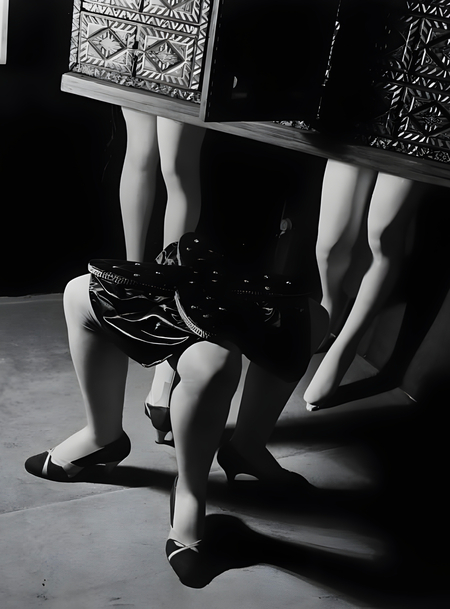
The «Anthropomorphic cabinet» Salvador Dali international surrealist exhibition of 1938. [website André Breton, 2021]
Small piece of furniture located along the wall of the atelier of André Breton.
Furniture facade decorated, gilded, painted and inlaid pieces of ivory painted. The central part, closed by a door, is framed by two rows of three drawers and two cabinets. Latches and handles on the sides of wrought iron. Presentation placed on the foot formed by four legs of a mannequin, in the international surrealist exhibition of 1938. [website André Breton, 2021] An installation by Salvador Dali depicting the real furniture, the cabinet, and the stool placed on the mannequin’s female legs. The installation was inaugurated by Andre Breton standing as one of the favourites at the show. As surrealism creators state that surrealism can be created by placing two non-identically or visually unlike parts together with or without any intellectual meaning. This installation definitely introduces us to that.
The Rainy Taxi
Salvador Dali
The rainy taxi, Salvador Dali 1938 www.messynessychic.com
Salvador Dali’s Rainy Taxi (now kept permanently at the Dali museum in Figueres) In this movie, Dali depicted a real black taxi with the interior connected to a running water system and two life-size mannequins, a male driver with a shark’s head designed with a mask, and the woman model at the back in the passenger seat with lettuce, creeping plants, and live snails crawling all over her body, and the face with water dripping from the ceiling of the taxi, which gives an irritation and intriguing scene of the installation. Besides, the setting may not be reflected in real life but just a dreamlike sensation and imaginary visions.
Kathy Hopewell explains; «In my novel „Swimming with the Tigers I have added live frogs, which Dali did indeed plan to include, and a pile of eggy liquid in the woman’s lap to anticipate the literally sickening conclusion to the scene.“ Source; [freewriterscompanion.com]
Following Kathy Hopewell’s description of the work by Dali, we will ignore the physical layout and look through the meanings as drawn by this author who seems to be irritated by how the surrealists went beyond the moral line in the description of a woman in these mannequin installations. Some of these scenes were not liked by the feminists claiming they were a dubious parade of provocative women. However, this was another approach invented by the surrealists looking forward to fighting rational thinking and freedom to create without being bound to rules and moral concerns.
The bird cage
Mannequin by Andrey Masson, 1938 International Surrealist exhibition. (Photo credit, Raoul Ubac)
Mannequin by Andrey Masson, Capturing the Installation from landmard 1938, International Surrealist exhibition in Paris. Photo by Raoul Ubac, Source, [ww.messynessy.com]
This work is one of the 16 decorated installations at the 1938 International Surrealist Exhibition in Paris, and besides one of the most famous installations shown. Placed in a dark hallway named «The beautiful streets of Paris». The artist attached a wicker cage engulfing the head of the dummy, the mouth covered with a velvet pansy flower which in French also gives a meaning of a «thought», symbolically meaning the women are entrapped in their thoughts or silenced women thought despite of the inequities. Besides symbolically placing a pubic wig made with feathers in a heart form.
Mannequin by Maurice Henry
Photography made during the international Exhibition of surrealism at the Galerie des Beaux-Arts in 1938 [Andre Breton Gallery]
Mannequin by Maurice Henry
Photography was made during the international Exhibition of surrealism at the Galerie des Beaux-Arts in 1938.
Mannequin by Roger Schall, International Surrealist exhibition Paris 1938, Source[www.andreybreton.fr]
Mannequin by Oscar Dominguez, International Surrealist Exhibition 1338, Photo by Denise Bellon, source[www.messynessychic.com]
Mannequin By Joan Miro, Photograph by Man Ray, International surrealist exhibition 1938, Source[www.andrebreton.fr]
However, we wrap up the mannequins by their claimed primary purpose, which was more feminine and an intellectual out-cry to the sex workers who assembled themselves on the streets of Paris with an erotic display. Perhaps these installations have a clear intellectual meaning within them, not just work as an end in themselves. Which Duchamp Constantly referred to as «Retinal» perceived and appreciated by the eye, and after that there is no intellectual meaning but just for aesthetics; hence, surrealism was particularly against just beauty without further services.
Re-thinking already mades as surreal Installations and video Avant-garde art
Re-thinking already mades as surreal Installations and video Avant-garde art.DUCHAMP’S VISION
«An artist can create simply by making choices»
As the father of conceptual art, Marcel Duchamp always had a different vision when it comes to his creativity. Little did he know that he was pioneering a move beyond the surreal and Dada with an intellectual freedom, giving a clear description with qualities of avant-garde but with its own features. Born in Blainville-Crevon, France, in 1887, the French, American artist is remembered for his vital role in pioneering the development of the avant-garde.
In his Intellectual statements he once said, ,«Let us consider two important factors, the two poles of the creation of art: the artist, on the one hand, and on the other the spectator who later becomes the posterity…if we give the attributes of a medium to the artist, we must then deny him the state of consciousness on the esthetic plane about what he is doing or why he is doing it. All his decisions in the artistic execution of the work rest with pure intuition and cannot be translated into a self-analysis, spoken or written, or even thought out.» Source[ «The Creative Act p. 28.».] In his statement, the artist kept on calling for the freedom for the artist in terms of material and the creative assemblage of the media to create art without being bound to what the viewers may perceive as art. The artist advocated for freedom of choice of material and how to assemble them considering that whatever is chosen by the artist is art, without paying attention to its primary purpose; this is clearly seen in his work of " The fountain» 1917 which is a urinal signed and sent to the Society of Independent Artists.
What are the «Ready mades»?
A statement invented by Duchamp which meant redefining already made functional objects into Art.
The bicycle wheel.
Ready mades as surrealism installations
Duchamp, in his style of conceptualizing the already made functional objects into artworks, is a literary alien style of creation, but this mimics the features of surrealism, where there is a strange combination of two objects that are completely alien to each other in other words, killing the harmony to create an essence of beauty in imaginations » Imagine a bicycle wheel on top of a stool», It looks completely strange and surreal but aesthetically interesting, In his exhibitions you always expect something as strange as this, but all aligned in institutional criticism. Why should it always be cast sculptures, pieces of intricate detailed paintings of the realistic sculptures of beautiful women and muscular young men, which were exhibited everywhere in the museums and galleries. Marcel Duchamp became a precursor of a new definition of art.
Bicycle Wheel, Marcel Duchamp 1916-17. The original 1913 version and this 2nd version are lost, source;[www.moma.org]
The Artist created this work 2 years before he invented the word «ready mades», his own word to mean artworks created by the choice of objects already manufactured for other functions. The work was created by placing a bicycle wheel on top of the stool and called it art, in Paris in 1913 in his studio. He made a replica of this work after the original got lost and this was done following the request of Sidney Janis who exhibited it in 1751 In new york. 'The original 1913 version of Bicycle Wheel has been lost or destroyed, making it impossible to verify the exact form of later versions. Duchamp recreated the work in 1921 and signed it after the original disappeared. Several authorized replicas followed. Sidney Janis produced a version in 1950, featuring a curved fork, exhibited in Climax in the XXth Century Art, Richard Hamilton created another replica with Duchamp’s approva’l.[wikiart.org]. Although the Artist claims that he never liked groups of artists and wanted to work on an individual basis Duchamps work depicted features of some of most of the Institutional critiques and they continued to Invite him to take part in their exhibitions, like the 1938 International Surrealist exhibition in Paris and Firts Papers of surrealism in New York 1942.
bigOriginal size 2000×1300 «The Fountain» Marcel Duchamp, 1917 https://fadmagazine.com
The fountain, 1917
Marcel Duchamp in 1917 purchased a Porcelain urinal tab, flipped it, he signed it with «R. Mutt 1917» with a tittle " The fountain»and then he submitted it to the Society of Independent Artists exhibition in New York accepted all artworks as long as the artist accepted to pay a certain amount. Then he submitted it to the Society of Independent Artists exhibition in New York, accepting all artworks as long as the artist accepted to pay a certain amount. Certainly the work was rejected by the society although Duchamp himself was part of the group that established the it. The original work actually was abandoned and got lost, and its traces only remained in the photograph taken by Alfred Stieglitz. This work is one of the conceptualized works of Marcel Duchamp which he termed with the concept of «Ready mades» Sending this work to the Society of Independent Artists exhibition in New York was a statement that art can be anything as far as it is chosen by the artist and given a particular new meaning is like giving it a new life from the original functional purpose as he bore a claim that; «An artist can create simply by making choices.»
Bottle Rack, 1915 Marcel Duchamp, source [https://www.artic.edu]
«In advance for a broken arm», Marcel Duchamp, 1914, https://www.moma.org/
Just as the «Bottle rack» and spade Installation with a tittle «In advance for a broken arm» were also ready made Installations by Duchamp even before the introduction of surrealism which openly shows that artists like Duchamp were already practicing surrealism in their exhibitions as early as 1914 and 1915 when these works were made consecutively even before surrealism was introduced in 1924. So, after the Introduction of Surrealism as a move in Institutional Criticism, they just fitted in perfectly.
The Twine Installation, First Papers of Surrealism 1942.
Installation, (South view), Marcel Duchamp
John Schiff, his twine at First Papers of Surrealism (South view), 1942. and Marcel Duchamp at Philadelphia Museum of Art. [toutfait.com]
The Twine , Installation, First Papers of Surrealism (South view), 1942.
The First Papers of Surrealism exhibition, which opened on October 14, 1942 at the Whitelaw Reid Mansion in midtown Manhattan, was both historic and peculiar. As heralded by Newsweek magazine, First Papers of Surrealism was the «biggest all-surrealist show ever seen in the United States.”It announced the arrival of Surrealism’s most celebrated artists, many of whom had recently left Europe to avoid the war.[toutfait.com] In this exhibition, Marcel Duchamp was tasked by Andre Breton, the exhibition organiser, to design the exhibition layout, and the artist decided to use 16 miles of string to design a spider web-like installation engulfing all the spaces and works in the exhibition ground. The visitors had a task of moving all through the threads to view the works.
John Schiff, his twine at First Papers of Surrealism (South view), 1942. at Philadelphia Museum of Art. [toutfait.com]
Edward Alden Jewell, the New York Times art critic, focused on the installation’s functional effects, reporting that, «[the twine] forever gets between you and the assembled art, and in so doing creates the most paradoxically clarifying barrier imaginable.”Some visitors, such as Harriet and Sidney Janis, on the other hand, opted for more metaphorical interpretations. They believed the installation represented the complexity of understanding contemporary art, writing that Duchamp’s use of twine „symbolized literally the difficulties to be circumvented by the initiate in order to see, to perceive and understand, the exhibitions.”[toutfait.com]
Duchamp never provided any description to the Installation but just claimed in an Interview in 1953 that the twine was nothing, not opaque but transparent and can be seen through,“It was nothing. You can always see through a window, through a curtain, thick or not thick, you can always see through if you want to, same thing there.“ Duchamp claimed in Kachur, 183 [brooklynrail.org]. The installation was beyond institutional criticism; it as well confused fellow surrealists who participated in the exhibition, claiming that the artist was „Merciless“, as they were not satisfied seeing their works viewed behind this disturbing barrier of the „Twine“.
Reconfiguration of Films into surreal Cinema.
Duchamp’s surreal-Dada cinema
The Anemic Cinema
Anemic Cinema Rrose Selavy (Originally Marcel Duchamp) 1924-26 7 minutes, 35 mm music; Gustavo Matamoro
Criticism is still traced in Duchamp’s understanding of cinema in this Avant-garde surreal-dada film by this artist which he created with help of Man Ray and filmmaker Marc Allegret in 1926. The film has no characters, story line, speech or any intellectual meaning but Just an optical array of illusions spinning with vibrating sounds and echoes. Some these illusions are made of words and spiral disturbing movements. At the end of the film is a text, » Copyrighted by Rrose Selavy 1926». It should be noted that Marcel Duchamp re-named himself and created female persona. A character replica of himself in a female version Rrose selavy the maker of this particular Film. This wraps up the traces of Institutional criticism in surrealist exhibitions and creations with video creations termed as films or cinema but in actual senses without any intellectual meanings attached to them but Just an expression of art In motion in an intriguing way of understanding the meaning behind them, but the artist himself bears no hope to describe the meaning but cleary displaying it as a movie. Besides, the tittle given to the movie also bears no clear sense of meaning even if it is traced, but Just linguistically transforming the word Cinema to Anemic by changing and re-locating the first two Letters of Cinema to Anemic.
CONCLUSION
Surrealism as a movement formed towards institutional criticism was not against rational artists, but for the artists to lubricate their creations with freedom of expression rather than being entangled to rational principles of creativity, aesthetics, morals, and trying to impress the Bourgeois and collectors. The rejection of «Retinal» art and exercising the freedom of creation extracts the natural meaning of art and gives it meaning for it is felt instead of merely looking at it as an end in itself. As it was stated in the manifesto of surrealism by Andre Breton, natural art is «the actual functioning of thought. Dictated thought, in the absence of any control exercised by reason, is exempt from any aesthetic or moral concern.» As he was describing surrealism.
uchloh, B. H. D. The Dialectics of Design and Destruction: The «Degenerate Art» Exhibition (1937) and the «Exposition internationale du Surréalisme» (1938) / B. H. D. Buchloh // October. — 2001. — Vol. 97. — P. 91–106. — DOI 10.1162/octo.2001.97.1.91.
Filipovic, E. Surrealism and the 1938 Exhibition / E. Filipovic // A Surrealist Stratigraphy of Dada and Surrealism. — London: Routledge, 2017. — P. 150–170.
Bishop, C. Installation Art: A Critical History [Text] / C. Bishop. — London: Tate Publishing, 2005. — 144 p.
Blessing, J. Peggy’s Surreal Playground / J. Blessing // Art of This Century: The Guggenheim Museum and Its Collection. — New York: The Solomon R. Guggenheim Foundation, 1993. — P. 45–62.
M., T. Exposition Internationale du Surréalisme, Paris 1938 / T. M. ; translated from French by M. Tüzel // E-skop Sanat Tarihi Eleştiri [Electronic resource]. — 2014. — Access mode: https://www.e-skop.com/skopdergi/expositioninternationale-du-surr%c3%a9alisme-paris-1938/1941 (accessed: 15.06.2025).
Janis, C. Three Encounters with Marcel Duchamp [Electronic resource] / C. Janis // The Brooklyn Rail. — 2022. — Access mode: https://brooklynrail.org/2022/10/criticspage/Three-Encounters-with-Marcel-Duchamp/ (accessed: 30.07.2024).
Duchamp, M. The Creative Act / M. Duchamp // ARTnews. — 1957. — Vol. 56, № 4. — P. 28–29.
Installation [Electronic resource] // Britannica Dictionary. — 2025. — Access mode: https://www.britannica.com/dictionary/installation (accessed: 12.05.2025).
Philadelphia Museum of Art [Электронный ресурс]. — Режим доступа: https://www.philamuseum.org (дата обращения: 28.05.2026).
Surrealism [Электронный ресурс] // The Metropolitan Museum of Art. — Режим доступа: https://www.metmuseum.org/ru/essays/surrealism (дата обращения: 28.05.2026). (Примечание: статья на сайте доступна, несмотря на технический сбой при парсинге, так как URL корректен. Если доступ ограничен, см. альтернативу ниже).
Альтернатива (если страница не открывается): Surrealism [Электронный ресурс] // The Metropolitan Museum of Art. — URL: https://www.metmuseum.org/ru/essays/surrealism (дата обращения: 28.05.2026).
Norton Simon Museum [Электронный ресурс]. — Режим доступа: https://www.nortonsimon.org/art/ (дата обращения: 28.05.2026).
Tanya Bonakdar Gallery [Электронный ресурс]. — Режим доступа: https://www.tanyabonakdargallery.com (дата обращения: 28.05.2026).
Mark Dion [Электронный ресурс] // Tanya Bonakdar Gallery. — 2018. — 27 April. — Режим доступа: https://www.tanyabonakdargallery.com/artists/34-mark-dion/ (дата обращения: 28.05.2026).
Fraser A. From the Critique of Institutions to an Institution of Critique [Электронный ресурс] // Artforum. — 2005. — September. — Режим доступа: https://www.artforum.com/features/from-the-critique-of-institutions-to-an-institution-of-critique-172201/ (дата обращения: 28.05.2026).
WikiArt [Электронный ресурс] // Wikipedia. — 2013. — 22 Feb. — Режим доступа: https://en.wikipedia.org/wiki/WikiArt (дата обращения: 28.05.2026).
The Museum of Modern Art (MoMA) [Электронный ресурс]. — Режим доступа: https://www.moma.org (дата обращения: 28.05.2026).
The Art Institute of Chicago [Электронный ресурс]. — Режим доступа: https://www.artic.edu (дата обращения: 28.05.2026).
FAD Magazine [Электронный ресурс]. — Режим доступа: https://fadmagazine.com (дата обращения: 28.05.2026).
Association André Breton [Электронный ресурс]. — Режим доступа: https://andrebreton.fr (дата обращения: 28.05.2026).
Messy Nessy Chic [Электронный ресурс]. — Режим доступа: https://messynessychic.com (дата обращения: 28.05.2026).